


What Is a False Log Book Violation?
False log book violations is an FMCSA compliance issue involving inaccurate, incomplete, altered, or misleading Hours of Service records. These records document driving time, rest periods, on-duty work, and off-duty status for commercial motor vehicle drivers.
Commercial drivers maintain Records of Duty Status through paper logs or Electronic Logging Devices under federal transportation rules. Accurate logs help DOT officers verify whether a driver followed HOS limits during roadside inspections, audits, and safety reviews.
Log falsification may involve incorrect driving-hour entries, manipulated duty-status records, missing information, or documents that conflict with vehicle movement. Serious violations can affect CSA scores, carrier safety profiles, CDL employment opportunities, and overall FMCSA compliance history.
What Types of Log Book Violations Exist?
Record accuracy, ELD use, supporting documents, Hours of Service limits, and driver certification all play a role in different types of log book violations.
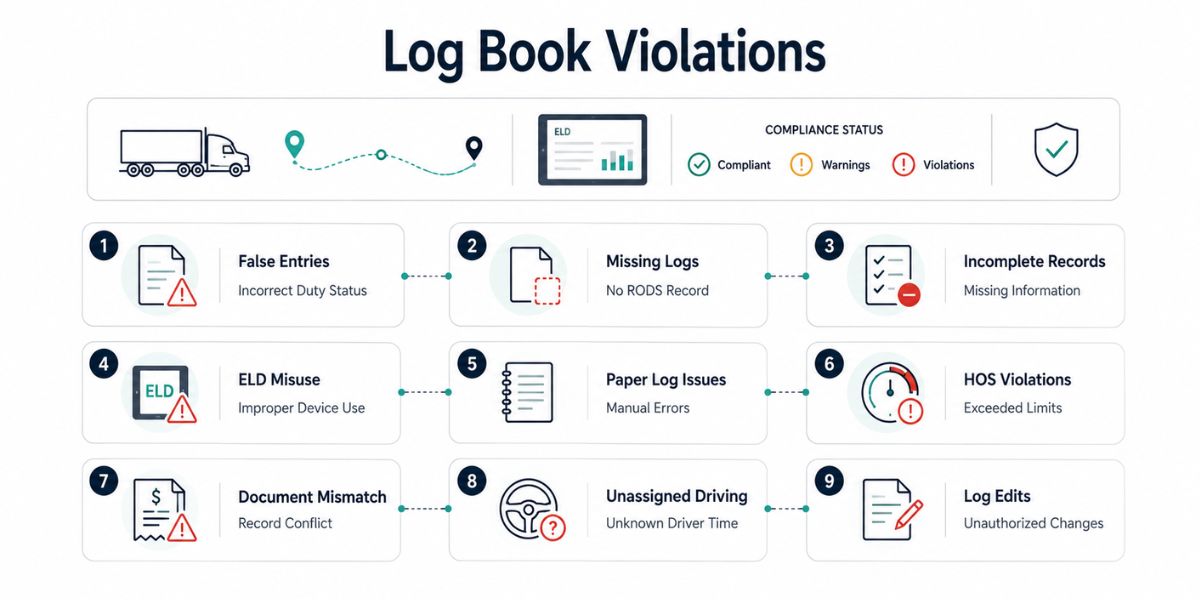
False Entries
False entries include duty-status records conflicting with actual driving, rest, or on-duty activity. Drivers may record off-duty time during active vehicle movement or reduce on-duty hours to appear compliant.
Missing Logs
Missing logs occur after drivers fail to provide required Records of Duty Status for one or more workdays. DOT officers may treat absent records as a serious compliance gap because HOS activity cannot be verified.
Incomplete Records
Incomplete records contain missing dates, locations, mileage, duty-status changes, signatures, or required annotations. Partial information makes FMCSA Hours of Service compliance harder to confirm during inspections.
ELD Misuse
ELD misuse includes using an uncertified device, failing to log in, skipping record certification, or refusing data transfer during inspection. Improper edits and unresolved unidentified driving time can also create violations.
Paper Logs
Paper log violations involve handwritten records with inaccurate, outdated, or inconsistent trip activity. Manual estimates for time, mileage, or duty-status changes often create compliance problems.
HOS Violations
HOS violations happen after drivers exceed legal driving limits, skip required breaks, or miss required off-duty periods. False logs often appear as an attempt to hide these underlying violations.
Document Mismatches
Document mismatches occur once fuel receipts, toll records, GPS data, bills of lading, or dispatch records conflict with log entries. External records can expose vehicle movement during claimed off-duty or sleeper berth time.
Unassigned Driving
Unassigned driving time appears after vehicle movement is recorded by an ELD but remains unassigned to a driver. Fleets must review and resolve this activity to avoid compliance issues during audits.
Log Edits
Log edits become violations without a valid reason, proper annotation, or driver confirmation. FMCSA expects edit history to remain visible so officers can review changes and explanations.
What Are the FMCSA Penalties for False Log Books?
Financial penalties, DOT investigations, safety record damage, and operational restrictions can result from false log book violations involving commercial drivers and motor carriers.
Civil Fines
Federal penalties apply after officers identify inaccurate, incomplete, or falsified Records of Duty Status. Current FMCSA penalty schedules allow fines reaching $1,584 per day, with maximum penalties up to $15,846 for continuing recordkeeping violations.
Out-of-Service Orders
Out-of-service orders temporarily stop commercial vehicle operation until compliance problems are corrected. Serious HOS violations connected to false records may remove vehicles or operators from active service during roadside inspections.
CDL Suspension
Commercial driving privileges may face suspension risks after repeated falsification violations or serious compliance failures. Employment opportunities can also decline once violations appear in PSP records or carrier safety history.
CSA Violations
CSA scores often increase after log-related violations appear during inspections or compliance reviews. Poor safety performance may trigger additional DOT scrutiny, insurance concerns, and operational pressure for trucking companies.
Compliance Audits
DOT investigations may expand after officers notice suspicious ELD edits, missing logs, or supporting document conflicts. Fuel receipts, GPS records, dispatch schedules, toll transactions, and bills of lading commonly become part of compliance reviews.
Criminal Charges
Severe cases involving intentional fraud, fatal accidents, or manipulated records may result in criminal investigations. Legal exposure increases once false logs conceal fatigue, excessive driving time, or unsafe operating practices.
Carrier Liability
Motor carriers can face penalties after accepting, encouraging, or ignoring inaccurate Hours of Service records. FMCSA enforcement actions may involve civil penalties, safety interventions, or formal compliance proceedings.
Can Drivers Lose Their CDL for False Logs?
False log violations can put a driver’s CDL at risk, especially after repeated Hours of Service violations, intentional falsification, or unsafe driving findings. A single paperwork mistake may not automatically cause license loss, but serious or repeated violations can lead to suspension, disqualification, or enforcement action.
Inspection history can also affect a driver’s PSP record, future hiring opportunities, and carrier trust. Trucking companies often treat false logs as a major safety issue because inaccurate records can hide fatigue, excessive driving time, or missed rest periods.
Crash investigations make false logs even more serious because officers may compare ELD records, GPS data, fuel receipts, and dispatch activity. If falsified records show unsafe operation or intentional concealment, the driver may face stronger penalties, legal exposure, and long-term career damage.
How Do DOT Audits Detect False Log Books?
DOT audits detect false log books by comparing the driver’s recorded Hours of Service with documents and data showing where the vehicle actually traveled, stopped, and operated.
- Fuel Receipts: Fuel receipts help auditors confirm truck location at a specific time. A log showing off-duty status in one city may be questioned once fuel records show activity hundreds of miles away.
- Toll Records: Toll records show highway movement, route direction, and travel timing. These records can reveal trips missing from the driver’s log book.
- GPS Data: GPS data shows actual vehicle location, movement, stops, idle time, and route history. Auditors use it to check whether logs match real driving activity.
- ELD History: ELD history shows duty-status changes, log edits, unidentified driving time, and driver login activity. Suspicious edits or unassigned movement can indicate possible log manipulation.
- Dispatch Records: Dispatch records show pickup times, delivery schedules, assigned routes, and load instructions. Auditors compare them with log entries to confirm driving and on-duty time.
- Bills of Lading: Bills of lading show shipment details, pickup locations, delivery locations, and freight timelines. Conflicts between freight documents and log books may lead auditors to question record accuracy.
- Scale Tickets: Scale tickets show vehicle weight, date, time, and location at weigh stations. They can prove truck operation in a place missing from the driver’s log.
- Inspection Reports: Roadside inspection reports show previous violations, inspection times, and vehicle locations. DOT auditors use them to identify patterns across trips, drivers, and fleet records.
How Do False Logs Affect CSA Scores and Safety Records?
CSA scores can increase after Hours of Service violations and false logs appear during roadside inspections, audits, or compliance reviews.
- HOS BASIC: Hours of Service violations fall under the HOS Compliance BASIC category in the CSA system. False logs can make a carrier appear less reliable in managing driver schedules, rest periods, and duty-status records.
- SMS Scores: Safety Measurement System scores may increase after repeated log violations appear in inspection data. Higher scores can signal greater compliance risk and may attract more DOT attention.
- Inspection Risk: Poor safety records can lead to more frequent roadside inspections and compliance reviews. Enforcement agencies often focus on carriers with repeated HOS problems or patterns of inaccurate records.
- Audit Triggers: False logs may become audit triggers once inspectors notice recurring mismatches in ELD data, fuel receipts, toll records, or dispatch documents. Repeated inconsistencies suggest weak internal controls or possible intentional falsification.
- Insurance Costs: Insurance providers may view log violations as a sign of higher operational risk. Poor CSA performance can contribute to increased premiums, stricter policy terms, or added underwriting concerns.
- Business Impact: Shippers and brokers often review safety performance before awarding contracts. A poor record linked to false logs can reduce trust, limit freight opportunities, and damage carrier reputation.
Read More: How to Check CSA Scores for Drivers?
What Is the Difference Between Paper Log and ELD Violations?
Paper log and ELD violations differ mainly in how Hours of Service records are created, reviewed, corrected, and verified during DOT inspections.
| Comparison Point | Paper Log Violations | ELD Violations |
| Record Format | Handwritten logs can include missing pages, unreadable entries, wrong dates, or incomplete duty-status changes. | Electronic logs can include missing certifications, device errors, failed data transfers, or incorrect driver logins. |
| Tracking Method | Drivers manually record driving time, rest periods, mileage, and locations. | Vehicle movement, engine activity, driving time, and duty status are captured automatically. |
| Common Errors | Mistakes often involve wrong mileage, estimated times, skipped duty changes, or entries made after the trip. | Issues often involve unassigned driving time, improper edits, missing annotations, or uncertified records. |
| Falsification Risk | Manual entries create higher risk because trip details can be changed without digital tracking. | ELD records are harder to manipulate because edit history, login activity, and movement data remain visible. |
| DOT Review | Officers compare written logs with receipts, tolls, mileage, and trip documents. | Officers review electronic records, transfer files, edit history, and unidentified driving activity. |
| Correction Process | Drivers may correct entries manually, but changes can be harder to verify later. | Edits require annotations, confirmation, and visible history for audit review. |
| Compliance Impact | Paper log issues often raise concerns around accuracy, missing records, and manual falsification. | ELD issues often point to system misuse, driver login problems, data transfer failures, or unresolved driving events. |
How Can Drivers and Fleets Prevent Log Book Violations?
Proper training, accurate recordkeeping, regular audits, and compliant ELD systems help drivers and fleets reduce Hours of Service violations and false log risks.
HOS Training
FMCSA Hours of Service training helps commercial drivers understand driving limits, rest break rules, sleeper berth requirements, and duty-status changes. Proper compliance education reduces inaccurate entries and operational mistakes during daily trips.
Daily Reviews
Daily log reviews help fleets identify missing records, suspicious edits, mileage issues, and incomplete duty-status activity before violations increase. Early correction also improves inspection readiness during DOT roadside checks.
ELD Systems
FMCSA-compliant ELD systems automatically record vehicle movement, engine hours, driving time, and duty-status activity. Automated tracking reduces manual entry mistakes and improves overall record accuracy.
Document Management
Fuel receipts, toll records, GPS reports, dispatch schedules, and bills of lading help confirm trip activity during audits. Organized supporting documents make compliance reviews faster and easier for fleet operations.
Driver Reporting
Open communication allows operators to report fatigue, delays, route changes, or scheduling pressure without hiding driving hours. Healthy reporting culture reduces falsification risks across fleet operations.
Internal Audits
Internal audits compare driver logs with GPS activity, trip timelines, fuel purchases, and dispatch records. Regular monitoring helps fleets identify repeated issues before enforcement actions begin.
Driving Activity
Unassigned driving activity should be reviewed and resolved regularly inside the ELD system. Unresolved movement records can create compliance concerns during inspections and audits.
System Maintenance
ELD maintenance helps prevent device malfunctions, failed data transfers, and missing records. Updated software and properly functioning systems reduce technical compliance problems across fleets.
How Matrack ELD Helps Reduce Log Book Violations?
Matrack ELD reduces log book violations by automatically recording driving time, engine hours, vehicle movement, location, and duty-status changes. Real-time updates help fleets maintain accurate records without depending on manual entries.
Compliance alerts notify drivers before possible violations, helping them manage driving limits and required breaks with fewer mistakes. DOT Inspection Mode also allows officers to review logs securely during roadside checks.
Fleet managers can use Matrack’s dashboard to monitor logs, DVIRs, GPS activity, IFTA reports, and compliance records in one place. Organized data makes audits simpler and helps reduce risks linked to missing records, false entries, and unsupported trip activity.