

A Bill of Lading (BOL) and Proof of Delivery (POD) serve different purposes in trucking, even though both are connected to freight movement. The BOL is created before transportation begins to record cargo details and shipping terms, while the POD confirms the load was successfully received at the destination.
Carriers rely on the Bill of Lading during transit because it contains important information like freight type, pickup location, destination, and handling instructions. After delivery, the Proof of Delivery verifies who accepted the load, when it arrived, and whether any damage or shortages were noticed during handoff.
Keeping both records accurate helps avoid confusion between shippers, carriers, and receivers throughout the transportation process. Proper paperwork also supports faster billing, smoother operations, and stronger claim validation when delivery issues happen.
What Is a Bill of Lading (BOL) in Trucking?
A Bill of Lading (BOL) in trucking is a legal freight document issued at pickup to record shipment terms, cargo details, and delivery instructions. Carrier acceptance of the load begins once that document is created and signed at origin.
Shipper, carrier, and consignee details appear on the document along with freight type, quantity, packaging, origin, and destination. NMFC classification, reference numbers, and handling notes may also be included for accurate freight movement.
BOL supports load verification, transit coordination, and delivery accuracy without replacing other delivery records. Properly completed paperwork helps reduce disputes, supports freight claims, and keeps shipment data consistent from origin to destination.
What Is Proof of Delivery (POD) in Trucking?
Proof of Delivery (POD) in trucking is a confirmation record completed after freight reaches the consignee and is received. Delivery status becomes officially documented once the receiving party signs and verifies the shipment.
Key details captured include receiver identity, delivery timestamp, signature, and visible freight condition at arrival. Notes about damage, missing items, or refused goods are added at this stage to reflect actual delivery outcomes.
Trucking workflows rely on POD to finalize shipments and validate service completion. Documented delivery evidence supports billing, reduces disputes, and plays a direct role in freight claim evaluation.
What Is the Main Difference Between POD and BOL?
The difference between Proof of Delivery (POD) and Bill of Lading (BOL) comes from their role in shipment flow, legal use, and freight documentation in trucking.
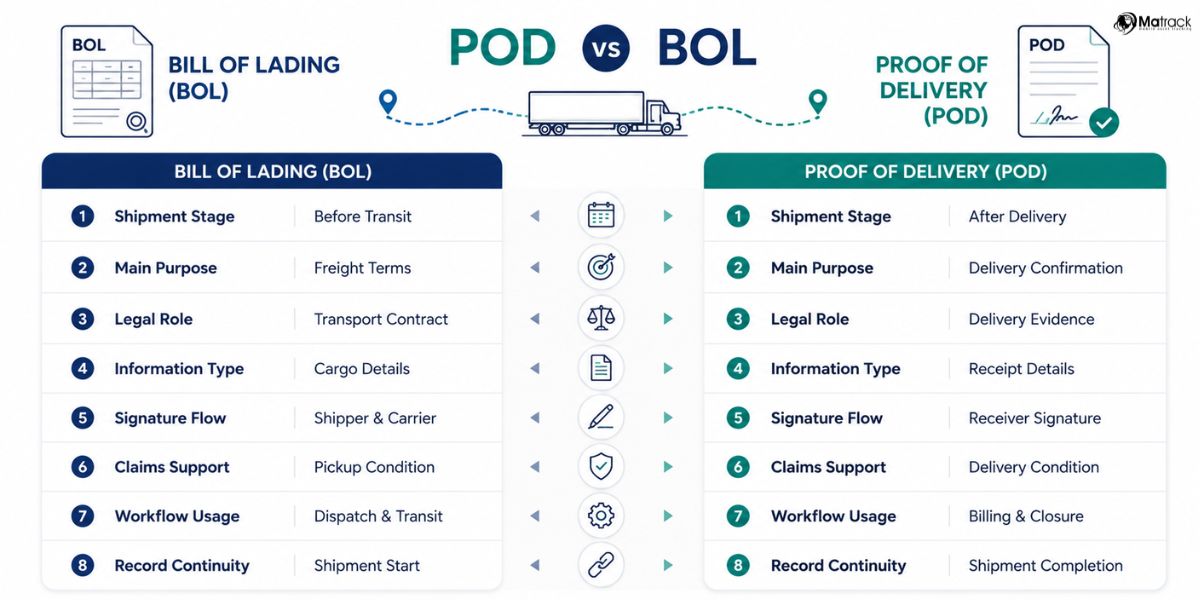
1. Shipment lifecycle stage
Bill of Lading is created at origin to record shipment details and transportation terms before freight moves. Proof of Delivery is completed after delivery once the consignee receives and verifies the shipment.
Separation across shipment stages makes the distinction easier to follow in trucking operations. One document starts the freight record, and the other closes it after final handoff.
2. Functional purpose
Shipment instructions, cargo details, and transport requirements are established through the Bill of Lading. Delivery confirmation, receipt validation, and condition reporting are handled through Proof of Delivery.
Roles remain separate because both records solve different operational needs. One governs freight movement, and the other confirms delivery results.
3. Legal significance
Contract of carriage is established through the Bill of Lading, which gives the shipment formal legal standing at pickup. Delivery acknowledgment recorded in Proof of Delivery becomes important evidence during disputes, shortages, or damage claims.
Legal accountability depends on accurate completion of both records during freight handling. Missing details or incomplete signatures can weaken claim support and create confusion around liability.
4. Information structure
Detailed shipment attributes such as freight class, quantity, packaging, origin, destination, and handling notes appear on the Bill of Lading. Delivery-related attributes such as receiver identity, timestamp, signature, and condition remarks appear on Proof of Delivery.
Basic shipment identifiers may appear on both records, but document focus changes the depth of information. Transport planning is emphasized in one, and delivery outcome is emphasized in the other.
5. Signature roles
Pickup confirmation requires signatures from the shipper and carrier on the Bill of Lading. Delivery confirmation requires a consignee or receiving party signature on Proof of Delivery.
Signature flow reflects responsibility at different points of the shipment process. Accountability moves from release of freight at origin to receipt of freight at destination.
6. Claims and liability
Freight condition at pickup is documented through the Bill of Lading, which helps establish the shipment’s starting point. Final condition at delivery is documented through Proof of Delivery, which helps determine what arrived and in what state.
Damage notes, shortages, or refused items recorded at delivery directly affect claim evaluation. Full claim context becomes harder to prove when either record is missing or incomplete.
7. Operational workflow
Load planning, dispatch coordination, and in-transit reference depend on the Bill of Lading throughout freight movement. Shipment closure, billing support, and service verification depend on Proof of Delivery after the load is delivered.
Operational accuracy improves when both records are used together rather than treated as substitutes. Coordinated documentation reduces errors and helps logistics teams maintain shipment visibility.
8. Documentation continuity
Bill of Lading opens the documented shipment trail at pickup and remains part of the freight record during transit. Proof of Delivery completes that record by confirming final receipt and delivery status.
Complete shipment documentation gives carriers, shippers, and consignees a traceable record from origin to destination. Consistent records support compliance, dispute handling, and freight accountability.
Final Thoughts
Bill of Lading and Proof of Delivery define two critical checkpoints in trucking documentation across shipment flow. One records shipment terms and freight details, and the other verifies delivery status and condition at destination.
Accurate use of both documents improves coordination between shippers, carriers, and consignees during freight movement. Proper records support billing, strengthen claim validation, and reduce operational confusion.
Documentation across pickup and delivery maintains accountability without gaps in shipment tracking. Reliable records keep freight operations traceable, controlled, and aligned from origin to final delivery.
Frequently Asked Questions
Who signs the Bill of Lading and Proof of Delivery?
Bill of Lading is signed by the shipper and carrier at pickup to confirm freight handover. Proof of Delivery is signed by the consignee at delivery to confirm receipt of the shipment.
What information appears on both documents?
Both documents include shipment details such as shipper, consignee, and basic freight description. Bill of Lading focuses on transport data, while Proof of Delivery focuses on delivery time, signature, and condition.
Why do POD and BOL matter for freight claims and liability?
Bill of Lading shows what was shipped and under what terms at origin. Proof of Delivery shows what was received at destination, including any damage or shortages used to support claims.
Can a Bill of Lading be used as proof of delivery?
A signed copy at delivery can sometimes act as delivery confirmation. Dedicated Proof of Delivery provides more accurate details about receipt and shipment condition.
Why do trucking companies need both POD and BOL?
Both documents create a complete shipment record from pickup to delivery. Using both improves tracking, billing accuracy, and dispute resolution.
What common documentation mistakes cause delivery disputes?
Common issues include missing signatures, incorrect shipment details, and failure to note damage or shortages. Poor documentation weakens claim support and creates confusion between parties.