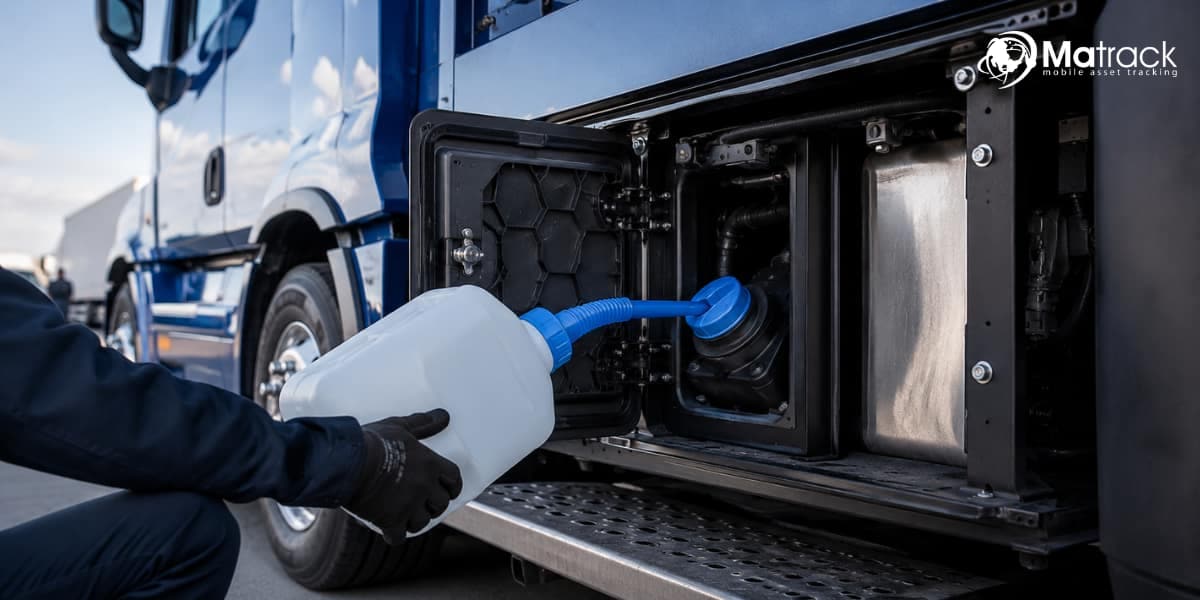


What Is Diesel Exhaust Fluid?
Diesel Exhaust Fluid, commonly called DEF, is a liquid used in modern diesel vehicles to help reduce harmful exhaust emissions. DEF is not diesel fuel, does not mix with diesel, and does not directly increase engine power or fuel performance.
Drivers add DEF to a separate DEF tank, where it supports the vehicle’s Selective Catalytic Reduction system. SCR technology uses DEF inside the exhaust system to break down nitrogen oxides, or NOx, which are pollutants created during diesel combustion.
Proper DEF levels help diesel trucks, vans, and heavy-duty vehicles meet required emissions standards during normal operation. Without enough DEF, the emissions system may trigger dashboard warnings, limit vehicle performance, or require service attention.
What Is DEF Made Of?
DEF is made of 32.5% high-purity urea and 67.5% deionized water, a fixed concentration designed for Selective Catalytic Reduction (SCR) systems. Diesel vehicles rely on this precise blend because the SCR process needs a stable chemical reaction to reduce nitrogen oxide (NOx) emissions effectively.
High-purity urea in DEF is a synthetic nitrogen compound made for automotive emissions systems, not the same as agricultural fertilizer-grade urea. During the SCR process, urea helps convert harmful NOx pollutants into nitrogen and water vapor before exhaust leaves the vehicle.
Deionized water makes up the remaining portion of DEF and acts as the carrier for the urea solution. Removing minerals and impurities helps protect SCR components from deposits, clogging, and inconsistent dosing inside the exhaust aftertreatment system.
How Does Diesel Exhaust Fluid Work?
Inside the Selective Catalytic Reduction (SCR) system, Diesel Exhaust Fluid is injected into the exhaust aftertreatment system to help convert nitrogen oxide (NOx) emissions from diesel combustion into less harmful gases before they leave the vehicle.
DEF Injection
DEF is stored in a separate tank and delivered through a dosing system into the exhaust stream. Injection occurs upstream of the SCR catalyst, with the amount precisely controlled based on engine load, exhaust temperature, and NOx levels.
Heat Conversion
High exhaust temperatures break DEF down into ammonia and carbon dioxide. Ammonia becomes the key active agent required for the emissions-reduction reaction inside the SCR system.
NOx Reduction
Ammonia reacts with nitrogen oxides inside the SCR catalyst and converts them into nitrogen and water vapor. Chemical reaction transforms harmful pollutants into safe, naturally occurring gases before they exit the tailpipe.
Sensor Control
NOx sensors placed before and after the SCR catalyst continuously monitor emission levels. Data from sensors allows the engine control unit (ECU) to adjust DEF dosing in real time, ensuring consistent emissions reduction and system efficiency.
What Is the Role of the SCR System?
Selective Catalytic Reduction (SCR) uses DEF inside the exhaust aftertreatment system to reduce nitrogen oxide (NOx) from diesel exhaust, completing the chemical conversion needed to produce safer exhaust gases.
Selective Catalytic Reduction (SCR) is the diesel exhaust aftertreatment system that uses DEF to reduce nitrogen oxide (NOx) emissions after fuel combustion. Instead of changing engine combustion, SCR treats exhaust gases before they leave the tailpipe and helps diesel vehicles meet emissions standards.
DEF Tank
Diesel Exhaust Fluid stays in a separate DEF tank so the emissions system has a dedicated supply for NOx reduction. Level, temperature, and quality sensors help monitor whether the fluid is available, usable, and within the right operating range.
Dosing Unit
Measured DEF injection happens through the dosing unit, which controls how much fluid enters the exhaust stream based on engine load, exhaust temperature, and emissions data. Accurate dosing prevents under-treatment of NOx, excess DEF use, and deposit buildup inside the exhaust aftertreatment system.
SCR Catalyst
In SCR catalyst, DEF breaks down into ammonia and reacts with nitrogen oxide in the exhaust. Chemical conversion in chamber changes NOx into nitrogen and water vapor, which are safer exhaust outputs.
NOx Sensors
Before and after exhaust passes through the SCR catalyst, NOx sensors measure emissions levels and feed data back to the vehicle’s control system. Sensor readings help adjust DEF dosing, monitor catalyst performance, and confirm that NOx reduction is working properly.
Which Vehicles Use DEF?
Modern diesel vehicles with Selective Catalytic Reduction (SCR) systems use Diesel Exhaust Fluid (DEF), especially newer diesel trucks, commercial vehicles, and heavy-duty equipment built to meet emissions standards.
- Diesel pickup trucks: Many newer heavy-duty pickups use DEF to control NOx emissions during towing, hauling, and daily driving.
- Semi-trucks: Long-haul diesel trucks rely on DEF because SCR systems help reduce emissions during high-mileage commercial operation.
- Delivery vehicles: Box trucks, vans, and last-mile delivery vehicles may use DEF when fitted with SCR-equipped diesel engines.
- Buses: School buses, transit buses, and shuttle buses often use DEF to reduce exhaust emissions in frequent stop-and-go routes.
- Construction equipment: Diesel excavators, loaders, cranes, and bulldozers may require DEF when built with SCR aftertreatment systems.
- Agricultural machinery: Tractors, harvesters, and sprayers often use DEF to meet emissions rules while handling heavy engine loads.
- Fleet vehicles: Commercial diesel fleets use DEF across trucks, vans, and equipment to maintain emissions compliance and vehicle uptime.
Why Do Diesel Engines Need DEF?
Diesel engines need DEF to control nitrogen oxide (NOx) emissions created during high-heat, high-pressure fuel combustion. NOx is a regulated exhaust pollutant, so modern diesel vehicles use emissions systems to reduce it before exhaust leaves the tailpipe.
Rather than changing the combustion process inside the engine, DEF works after fuel has already burned. Inside the Selective Catalytic Reduction (SCR) system, DEF reacts with diesel exhaust to help convert NOx into nitrogen and water vapor.
Proper DEF use allows SCR-equipped diesel trucks, commercial vehicles, and heavy-duty equipment to meet emissions requirements while maintaining normal engine operation. Low DEF levels or poor-quality DEF can trigger dashboard warnings, performance limits, or compliance-related service issues.
How Often Should You Refill DEF?
Refill timing for DEF depends on how much the vehicle is driven and how hard the engine works.
- Light-duty use: Refill around every 5,000–10,000 miles.
- Regular driving: Expect about 2–3 gallons per 800–1,000 miles.
- Heavy-duty use: Refill sooner during towing, hauling, idling, or long-distance routes.
- First alert: Plan a refill once the DEF level warning appears.
- Second alert: Add DEF before the vehicle limits driving range.
- Final alert: Refill immediately to avoid reduced engine power.
- Service intervals: Check DEF during oil changes and scheduled maintenance.
- Long routes: Top off DEF before road trips, fleet routes, or towing jobs.
- Low levels: Avoid waiting until the DEF tank is nearly empty.
What Happens If You Run Out of DEF?
Running out of DEF triggers dashboard warnings before the vehicle reaches an empty DEF tank. Most SCR-equipped diesel vehicles alert the driver in stages, starting with a low-level warning and then showing stronger messages as the remaining driving range decreases.
Once DEF is empty, the vehicle may reduce engine power, limit speed, or enter limp mode. These restrictions happen because the SCR system can no longer reduce NOx emissions properly without DEF.
Restarting may also be restricted in some vehicles until DEF is refilled. Adding the correct DEF usually clears the issue after the system detects enough fluid, but persistent warnings may require inspection for sensor, pump, or dosing-system problems.
How Should DEF Be Stored and Handled?
Proper storage and handling keep DEF pure, stable, and ready for the SCR system. Contaminated or degraded Diesel Exhaust Fluid can damage the dosing injector, DEF pump, NOx sensors, or SCR catalyst.
| DEF Storage/Handling Point | What to Do | Why It Matters |
| Container | Keep DEF in sealed, original containers. | Prevents dust, dirt, fuel, and water contamination. |
| Temperature | Store in a cool, shaded place. | High heat can shorten shelf life and reduce fluid quality. |
| Freezing | Allow frozen DEF to thaw naturally. | DEF can freeze, but thawed DEF remains usable if uncontaminated. |
| Dispensing | Use clean, DEF-only funnels or pumps. | Shared equipment can introduce diesel, oil, or minerals. |
| Mixing | Never mix DEF with diesel, water, coolant, or additives. | Mixing can damage SCR components and trigger system faults. |
| Quality | Use DEF that meets ISO 22241 standards. | Certified DEF protects the emissions system and ensures proper NOx reduction. |
Is DEF the Same as AdBlue or BlueDEF?
DEF, AdBlue, and BlueDEF refer to the same type of emissions-control fluid used in diesel vehicles with Selective Catalytic Reduction (SCR) systems. Diesel Exhaust Fluid is the generic term, AdBlue is a registered trademark commonly used in Europe, and BlueDEF is a commercial brand sold in the market.
Chemical composition stays the same when the fluid meets required quality standards: 32.5% high-purity urea and 67.5% deionized water. SCR-equipped diesel trucks, vans, and heavy-duty equipment use this fluid to help reduce nitrogen oxide (NOx) emissions in the exhaust aftertreatment system.
Brand choice usually depends on availability, certification, container size, and storage condition rather than performance differences. Vehicle owners should check for DEF that meets ISO 22241 standards and avoid contaminated, diluted, or expired fluid that can affect SCR operation.
Can DEF Damage a Diesel Engine?
When used correctly, DEF does not damage a diesel engine because it operates in a separate tank and functions only within the exhaust aftertreatment system. Normal usage through the SCR system remains safe and is required for proper emissions control.
Problems occur if DEF is used incorrectly, especially if it is poured into the diesel fuel tank or if diesel fuel enters the DEF tank. Such contamination can damage fuel injectors, pumps, and other critical components, leading to costly repairs and system failure.
Contaminated or poor-quality DEF can also affect the SCR system by clogging the DEF injector, damaging sensors, or reducing catalyst efficiency. Using certified DEF, storing it properly, and keeping fuel and DEF systems separate prevents these issues.
What Should Fleet Managers Know About DEF Maintenance?
Fleet managers should treat DEF maintenance as part of preventive maintenance because missed refills, contaminated fluid, ignored DEF warnings, and poor storage practices can lead to downtime, route delays, and SCR system issues.
- Monitor DEF levels: Track fluid levels before long routes and high-load operations to avoid mid-route warnings or restrictions.
- Track DEF consumption: Analyze usage patterns per vehicle to detect abnormal consumption or potential system issues.
- Use certified DEF: Choose DEF that meets ISO 22241 standards to protect SCR components and ensure proper emissions control.
- Prevent contamination: Store DEF in sealed containers and use dedicated dispensing equipment to avoid system damage.
- Train drivers: Ensure drivers understand DEF usage, warning signals, and the difference between diesel fuel and DEF.
- Respond to alerts early: Handle dashboard warnings immediately to prevent limp mode or operational limits.
- Plan refills strategically: Align DEF refills with maintenance schedules and route planning to reduce downtime.
- Prepare for cold conditions: Account for DEF freezing in low temperatures and ensure vehicles have proper heating systems.
How Matrack Helps With Diesel Fleet Maintenance
Managing DEF across a fleet becomes complex when vehicles operate under different routes, loads, and driving conditions. Without consistent visibility, issues like missed refills, abnormal consumption, or delayed response to warnings can impact uptime and emissions compliance.
Matrack GPS Fleet Tracking supports diesel fleet operations by improving visibility into vehicle usage, route patterns, and driver behavior. Insights help fleet managers anticipate maintenance needs, align DEF refills with actual vehicle usage, and reduce the risk of unexpected interruptions.
Better tracking leads to better planning. With centralized data and real-time monitoring, fleets can stay proactive instead of reactive, keeping vehicles compliant, reducing downtime, and maintaining smoother day-to-day operations.
Frequently Asked Questions
1. How much DEF does a diesel vehicle use per gallon of fuel?
Most diesel vehicles consume DEF at a rate of about 2–3% of diesel fuel usage. Means for every 100 gallons of diesel burned, around 2–3 gallons of DEF are typically used.
2. Can you overfill the DEF tank?
Overfilling a DEF tank is not recommended because it can lead to overflow or crystallization around the filler area. Proper filling up to the indicated level helps maintain system accuracy and prevents handling issues.
3. Why does my vehicle say “Incorrect DEF” or “Poor DEF Quality”?
Such warnings usually appear when the DEF is contaminated, diluted, or not meeting ISO standards. Sensor errors or crystallization in the system can also trigger alerts.
4. Does DEF affect fuel economy?
DEF itself does not directly improve fuel economy, but SCR systems allow engines to run more efficiently. This indirect optimization can help maintain better fuel performance under load.
5. What happens if DEF is spilled on the vehicle?
DEF can leave white crystal residue when it dries, especially on painted surfaces. Cleaning the spill with water immediately prevents staining or buildup.
6. Do all diesel vehicles have a DEF gauge or indicator?
Most modern diesel vehicles include a DEF level indicator or warning system on the dashboard. Older or non-SCR diesel engines may not have DEF systems or gauges at all.