

What Is Last Mile Delivery in Logistics?
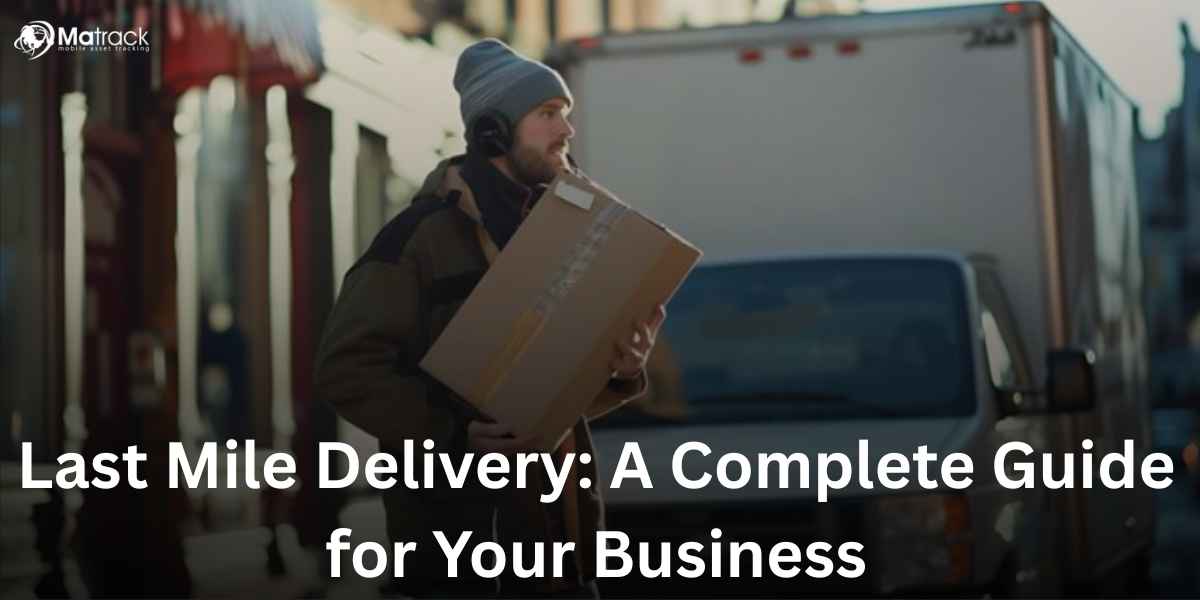
Last mile delivery is the final stage of the supply chain where goods move from a distribution hub or fulfillment center to the customer’s location. It is the point where logistics operations connect directly with the end user.
The meaning of “last mile” is not limited to distance but represents the final leg that completes the delivery journey. Operations in this stage involve coordination between carriers, routes, and delivery schedules.
Role within logistics is critical as it determines how orders reach customers in real-world conditions. Focus on this stage continues to grow as businesses aim to improve delivery outcomes and customer satisfaction.
How Does Last Mile Delivery Work?
Last mile delivery works through a structured flow where orders move from local hubs to customers using coordinated logistics systems.
- Order Processing: Orders get picked, packed, and prepared at a fulfillment center before entering the delivery network. Shipment details are verified to ensure accurate routing and delivery execution.
- Local Hub Transfer: Packages move to a nearby distribution hub based on delivery location. This step reduces travel distance and improves delivery speed.
- Route Assignment: Routes are created through optimization systems based on stop locations, traffic conditions, and delivery windows. Drivers receive assigned routes for smooth execution.
- Out for Delivery: Packages are loaded into delivery vehicles and dispatched for final movement. Drivers follow planned routes while adapting to real-time conditions.
- Final Delivery: Orders reach the customer’s address and are handed over or securely placed. Delivery status gets updated instantly through tracking systems.
- Confirmation & Updates: Systems record delivery completion with proof such as signatures or photos. Customers receive notifications confirming successful delivery.
What Are the Key Components of Last Mile Delivery?
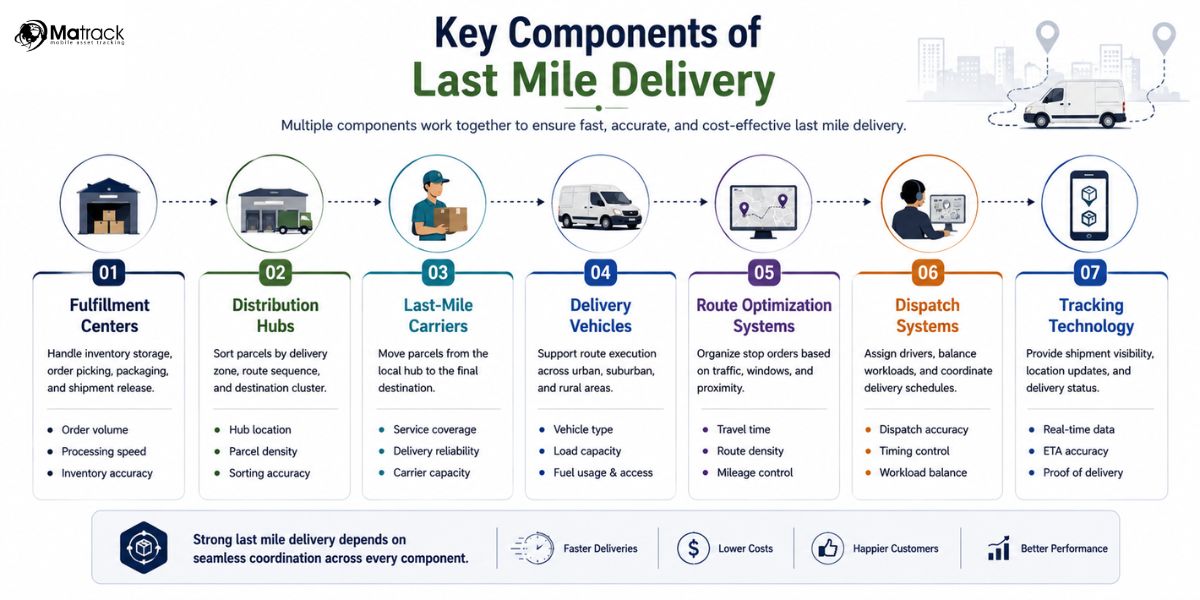
Core last mile operations rely on infrastructure, transportation assets, routing software, dispatch coordination, and shipment visibility.
Fulfillment Centers
Fulfillment centers handle inventory storage, order picking, packaging, and shipment release. Order volume, processing speed, and inventory accuracy at this stage affect downstream delivery performance.
Distribution Hubs
Distribution hubs sort parcels by delivery zone, route sequence, and destination cluster. Hub location, parcel density, and sorting accuracy influence delivery speed and stop productivity.
Last-Mile Carriers
Last-mile carriers manage parcel movement from the local hub to the final destination. Service coverage, delivery reliability, and carrier capacity shape customer experience during the final stage.
Delivery Vehicles
Delivery vehicles support route execution across urban areas, suburban neighborhoods, and rural routes. Vehicle type, load capacity, fuel usage, and road access affect delivery cost and route flexibility.
Route Optimization Systems
Route optimization systems organize stop orders based on traffic patterns, delivery windows, and geographic proximity. Travel time, route density, and mileage control improve when routing decisions follow real delivery conditions.
Dispatch Systems
Dispatch systems assign drivers, balance workloads, and coordinate delivery schedules across active routes. Dispatch accuracy, timing control, and workload distribution support daily delivery consistency.
Tracking Technology
Tracking technology provides shipment visibility, location updates, and delivery status throughout the final mile. Real-time data, estimated arrival timing, and proof of delivery improve operational control and customer communication.
Why Is Last Mile Delivery Important for Businesses?
Customer expectations are shaped most visibly during the final delivery stage, where shipping speed, order accuracy, and tracking visibility influence the overall buying experience. Delivery delays, missed drop-offs, and poor communication can affect brand trust, customer satisfaction, and repeat purchases.
Operational pressure also becomes more intense in the final mile because businesses must manage fuel usage, labor time, route density, delivery windows, and failed attempts across multiple stops. Cost control, service reliability, and daily logistics performance depend on how well carriers, dispatch systems, and route planning tools handle those moving parts.
Growth in ecommerce has made final-mile execution even more important across retail and logistics. U.S. retail e-commerce sales reached $316.1 billion in Q4 2025 and accounted for 16.6% of total retail sales, showing how closely delivery performance is tied to modern order fulfillment.
What Are the Benefits of Last Mile Delivery?
Reliable final-mile operations create measurable value across customer service, delivery performance, and logistics planning.
Faster Delivery Times
Faster delivery times help businesses meet customer expectations around quick order fulfillment. Shorter transit duration also improves order flow across high-volume delivery operations.
Customer Satisfaction
Customer satisfaction improves as shipments arrive on time with accurate tracking updates. Shipment visibility and stable service quality often influence repeat purchases and brand trust.
Cost Control
Cost control becomes easier when routes follow optimized stop sequences and failed delivery attempts stay low. Fuel usage, labor hours, and route mileage remain easier to manage under structured delivery planning.
Route Productivity
Route productivity improves as delivery zones, stop density, and dispatch timing align with real operating conditions. Higher stop output allows more orders to move through the same fleet capacity.
Service Reliability
Service reliability strengthens as businesses maintain accurate time commitments and last-mile execution. Stable outcomes reduce customer complaints, missed handoffs, and order disruption.
Why Is Last Mile Delivery So Expensive?
Last mile delivery is expensive because it involves delivering individual packages to individual destinations, which requires more time, labor, fuel, and coordination than earlier bulk transportation stages. Cost per shipment increases in the final mile since every stop adds route time, delivery effort, and operational overhead.
Pressure on logistics costs rises as shipments move through urban traffic, rural distances, tight time constraints, and changing route conditions. Labor allocation, fuel consumption, vehicle usage, and stop density all affect how much businesses spend to complete final-mile operations.
Cost challenges also grow when failed deliveries, returns, and repeated attempts interrupt planned routes and reduce daily delivery productivity. Customer expectations around fast shipping, real-time tracking, and convenient service make last mile delivery one of the most resource-intensive parts of the supply chain.
What Are the Common Challenges in Last Mile Delivery?
Multiple operational barriers affect final delivery performance across routes, carriers, and customer locations.
Traffic Congestion
Traffic congestion disrupts planned delivery routes and increases transit time across urban areas. Road conditions, peak hours, and access restrictions reduce delivery speed and schedule accuracy.
Failed Deliveries
Failed deliveries occur when customers are unavailable, addresses are incorrect, or communication gaps exist. Reattempts increase delivery costs, reduce route productivity, and delay order completion.
Low Delivery Density
Low delivery density reduces the number of stops completed within a single route. Rural areas and scattered locations increase distance per delivery, raising cost per shipment.
Route Inefficiency
Route inefficiency results from poor stop sequencing, lack of real-time adjustments, or outdated planning systems. Unoptimized routes increase fuel usage, travel time, and operational effort.
Limited Visibility
Limited visibility restricts real-time tracking of shipments, vehicles, and delivery progress. Lack of accurate updates affects decision-making, customer communication, and issue resolution.
Customer Expectations
Customer expectations around fast shipping, precise timing, and live tracking continue to rise. Gaps between expectation and execution impact satisfaction and brand perception.
What Technologies Are Used in Last Mile Delivery?
Modern last mile operations depend on digital systems, tracking tools, and automation platforms to manage delivery performance across routes and carriers.
GPS Tracking Systems
GPS tracking systems provide real-time location data for delivery vehicles across active routes. Location visibility helps monitor delays, track movement, and improve delivery coordination.
Delivery Management Systems
Delivery management systems control dispatching, order allocation, and delivery status updates across operations. Centralized platforms improve coordination between drivers, hubs, and customer communication.
Telematics Systems
Telematics systems collect vehicle data such as speed, idling, and route behavior during delivery operations. Fleet insights support performance monitoring, fuel control, and driver accountability.
Automation and AI Tools
Automation and AI tools support demand forecasting, route prediction, and delivery planning decisions. Data-driven systems help improve accuracy, reduce manual effort, and support scalable operations.
How Can Businesses Optimize Last Mile Delivery?
Improvement in last mile delivery depends on control over routing, delivery execution, fleet operations, and real-time visibility.
Route Optimization
Route optimization improves flow by organizing stops based on distance, traffic patterns, and priority constraints. Structured routing reduces travel time, fuel usage, and delays.
Real-Time Tracking
Real-time tracking provides continuous visibility into vehicle location, shipment status, and route progress. Live data supports faster decisions during delays or disruptions.
Multi-Carrier Strategy
Multi-carrier strategy allows businesses to select delivery partners based on location, cost, and service level. Carrier flexibility improves coverage and reduces dependency on a single provider.
Delivery Slot Management
Delivery slot management aligns shipments with customer availability and preferred time windows. Scheduled delivery reduces failed attempts and improves route planning.
Fleet Visibility
Fleet visibility provides insights into vehicle movement, driver activity, and route behavior. Operational data helps identify inefficiencies and improve delivery consistency.
Micro-Fulfillment Centers
Micro-fulfillment centers position inventory closer to delivery zones and high-demand areas. Shorter distance between inventory and customers improves delivery speed and reduces transportation cost.
Driver Performance Monitoring
Driver performance monitoring tracks behavior such as speed, idling, and route adherence. Performance data supports training, accountability, and improved delivery execution.
Customer Communication
Customer communication provides delivery updates, estimated arrival times, and notifications. Clear communication reduces missed deliveries and improves overall customer experience.
What Is the Future of Last Mile Delivery?
Future trends in last mile delivery point toward faster, smarter, and more technology-driven logistics operations.
Automation
Automation will support sorting, dispatching, and delivery coordination across high-volume operations. Automated systems can reduce manual effort and improve processing speed at different delivery stages.
Artificial Intelligence
Artificial intelligence will improve route planning, demand forecasting, and delivery decision-making. AI models can analyze traffic patterns, order volume, and delivery behavior to support more accurate logistics planning.
Electric Vehicles
Electric vehicles will play a larger role in final-mile transportation as businesses look for lower fuel costs and reduced emissions. Fleet electrification can also support sustainability goals across urban delivery networks.
Micro-Fulfillment Centers
Micro-fulfillment centers will place inventory closer to customers in high-demand areas. Shorter travel distance between stock points and delivery zones can improve delivery speed and reduce transportation cost.
Real-Time Visibility
Real-time visibility will remain central to future delivery operations as customers expect precise updates and accurate arrival estimates. Shipment tracking, fleet monitoring, and proof of delivery will continue to shape service quality.
Delivery Personalization
Delivery personalization will become more important as customers expect flexible time slots, location preferences, and communication options. Customized delivery experiences can improve satisfaction and reduce failed delivery attempts.
Sustainable Logistics
Sustainable logistics will influence routing decisions, vehicle selection, and packaging strategies across the final mile. Environmental goals will push businesses to balance delivery speed with lower operational impact.
Improve Your Last Mile Delivery With Matrack GPS Fleet Tracking
Matrack GPS Fleet Tracking supports last mile delivery by giving businesses real-time visibility into vehicle movement, route progress, and delivery activity. Live GPS tracking helps dispatchers monitor every vehicle on the road and stay updated on shipment status throughout the final delivery stage.
Operational control improves through instant alerts, driver behavior monitoring, and vehicle health insights that help teams respond quickly to issues. Speeding, harsh braking, unexpected stops, and maintenance-related problems can be identified early to reduce delays and keep delivery schedules on track.
Platform access across desktop and mobile devices makes fleet management more flexible during daily operations. Route adjustments, driver coordination, and delivery planning can be handled from anywhere, helping businesses maintain reliable last mile performance.