

What Is a DOT Number?
A USDOT number is a unique identifier issued by the Federal Motor Carrier Safety Administration for businesses that run regulated vehicles in the United States. FMCSA uses the number to connect a company’s profile, vehicles, drivers, inspections, crash reports, and safety history in one federal record.
Regulators rely on that record to monitor safety performance and enforce commercial motor vehicle rules. Data tied to a USDOT number helps inspectors, auditors, and enforcement agencies review how an operator performs over time.
For companies covered by FMCSA rules, the USDOT number acts as an official regulatory identity. Without it, many regulated vehicle activities cannot legally run in interstate commerce or in certain state-regulated intrastate situations.
Who Needs a DOT Number in 2026?
Companies using vehicles that meet FMCSA requirements need a DOT number in 2026. Covered vehicles include those with a gross vehicle weight rating or gross combination weight rating of 10,001 pounds or more, vehicles carrying placarded hazardous materials, and vehicles transporting passengers above federal limits.
Carriers crossing state lines for regulated transportation must register at the federal level before operating. State rules may also require a DOT number for intrastate activity, so companies working only within one state still need to check local requirements.
Eligibility depends on how the vehicle is used, not the size of the company. Owner-operators, single-truck businesses, and small fleets must register if vehicle weight, cargo type, passenger activity, or travel area meets DOT number requirements.
What Do You Need Before Applying for a DOT Number?
Before opening the FMCSA application have these details ready, incomplete or inconsistent information mid-form causes delays and incorrect registrations.
- Legal Business Name & DBA: Use your officially registered business name and any “Doing Business As” name exactly as filed in your records.
- EIN or SSN: Provide an Employer Identification Number for businesses or a Social Security Number for sole proprietors.
- Primary Location: Enter your primary location, mailing address, phone number, and email used for official FMCSA communication.
- Business Structure: Identify whether your company is a sole proprietorship, partnership, LLC, or corporation, as this affects registration classification.
- Operation Type: Specify whether your vehicles operate across state lines or only within one state.
- Carrier Type: Indicate whether you transport goods for payment or move only your own company’s goods.
- Vehicle Information: Provide the number of vehicles, their type, and weight classification (GVWR/GCWR).
- Cargo Type: Define what you haul, such as general freight, passengers, hazardous materials, or other cargo categories.
- MC Number Need: Determine whether your business also requires operating authority, since for-hire interstate carriers may need it alongside a DOT number.
How to Get a DOT Number: Step-by-Step
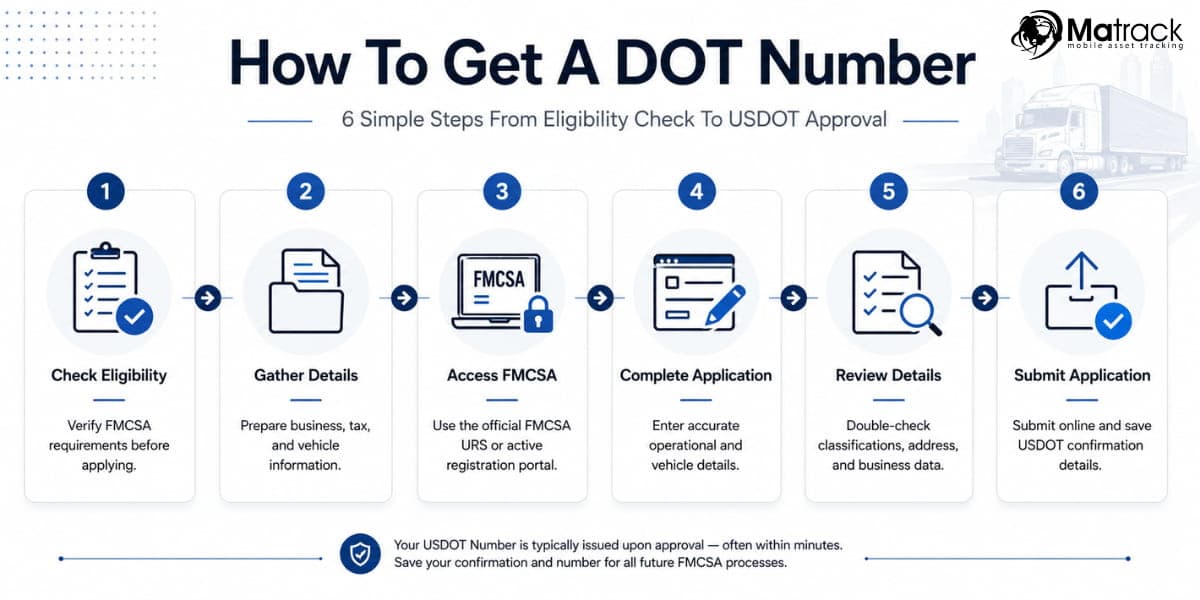
Six steps take a business from checking whether it needs a DOT number to submitting the FMCSA application and saving the issued USDOT number for future compliance records.
Step 1: Check Eligibility
Eligibility should be checked against FMCSA rules for vehicle weight, passenger capacity, and cargo type before any filing begins. Applying without checking first can result in incorrect classification or unnecessary registrations. Verification also shows whether your business may need filings beyond a basic DOT number, reducing confusion before the application opens.
Step 2: Gather Details
Required details should be ready before the form opens, including business identity, tax information, vehicle data, and operating classification. Incomplete or inconsistent entries cause delays and produce a DOT profile that doesn’t reflect actual operations, creating problems during future FMCSA compliance checks.
Step 3: Access FMCSA
Go to the official FMCSA Unified Registration System (URS) to begin your USDOT Number application. Agency registration systems are moving toward the Motus Registration System in 2026, so carriers should use the platform currently designated as active. Avoid third-party websites and outdated portals, only official FMCSA submission is valid, and third-party platforms have no authority to issue or record a USDOT number.
Step 4: Complete Application
Enter details that match the company’s legal records, vehicle information, and day-to-day activity. Classification questions determine which federal standards apply, and motor carrier authority questions may appear at this stage. Accurate answers keep the registration aligned with the business model.
Step 5: Review Details
Review every field before submitting, especially the business name, address, classification, vehicle details, and service area. Small errors become harder to fix after submission. A final check helps the DOT record match both the legal registration and how the business actually runs.
Step 6: Submit Application
Submit through the FMCSA system and save your confirmation details immediately. A USDOT Number is typically assigned upon approval, often within minutes of online submission. So keep a record of both the confirmation and the assigned number, since all future FMCSA processes will reference it.
How Much Does a DOT Number Cost?
Direct USDOT number registration through FMCSA costs $0. Government issuance of the number is free, so carriers do not pay a federal fee for the basic DOT registration.
Operating authority creates a separate expense for carriers that need MC authority. Authority applications carry a $300 filing fee per authority type, which can increase the total if the business applies for multiple authorities.
BOC-3 process agent services, insurance filings, UCR registration, and optional third-party filing help may add separate charges. Those expenses are related compliance costs, not fees for getting the DOT number itself.
How Long Does It Take to Get a DOT Number?
Online DOT number registration usually takes about 20 minutes through the FMCSA MCS-150 process. Once a complete application is submitted and approved, the USDOT number is typically issued immediately.
Delays usually come from missing fields, mismatched business details, or incorrect classifications. Manual review may be required if the application does not match the carrier’s legal, vehicle, or operation information.
Mailed MCS-150 filings take much longer than online registration. Paper submissions can take around four to six weeks, which makes online filing the practical option.
What Should You Do After Getting a DOT Number?
Receiving a DOT number is the starting point, activating authority, meeting insurance requirements, and preparing for audits all follow.
- MC Authority: File for Motor Carrier (MC) authority if operating for-hire across state lines and pay the required FMCSA fee.
- Process Agent Filing: Assign a process agent in each state through a BOC-3 form to legally receive documents.
- Insurance Coverage: Secure required liability and cargo insurance, then your provider files it with FMCSA.
- Drug Testing Program: Register drivers in a DOT-compliant testing program and join the FMCSA Clearinghouse.
- Display USDOT Number: Mark your vehicles with the USDOT number as per FMCSA visibility guidelines.
- Driver Files: Maintain driver qualification files with licenses, medical certificates, and background checks.
- Install ELD: Use an ELD device to track Hours of Service and stay compliant with HOS regulations.
- New Entrant Audit: Maintain safety records, maintenance logs, and policies for the FMCSA audit within 12 months.
- UCR Registration: Complete Unified Carrier Registration annually based on fleet size.
- Track IFTA: Register for International Fuel Tax Agreement if working across multiple states.
Mistakes to Avoid When Applying for a DOT Number
Avoiding common application mistakes helps prevent delays, incorrect registration, and compliance problems later.
- Correct Business Details: Enter your legal business name, EIN, address, and contact details exactly as they appear in official records. Mismatched information can create verification issues and delay registration.
- Right Operation Type: Select the correct carrier operation, cargo type, and business classification during the application. Incorrect selections can place the company under the wrong FMCSA requirements.
- Complete All Information: Fill out every required section with complete and accurate details before submitting the form. Missing data often leads to processing delays or registration errors.
- Use Official FMCSA: Use the official FMCSA registration platform instead of third-party or outdated websites. Unofficial sources can cause extra costs, bad guidance, or incorrect filings.
- Review Before Submission: Check names, addresses, vehicle details, and classification entries carefully before finalizing the application. Post-submission corrections can take longer once basic details are filed incorrectly.
- Avoid Duplicate Applications: Submit the form once and keep the confirmation for your records. Multiple submissions can create duplicate records and unnecessary confusion.
- Know Operating Scope: Choose the correct operating scope based on how and where your business runs. Wrong selection can affect your registration and compliance obligations.
Do You Also Need a BOC-3, Insurance Filing, or Operating Authority?
After receiving a DOT number, additional filings depend on how the operation is structured. For-hire authority, insurance filings, BOC-3 designation, and UCR registration apply under different conditions, so carriers should separate the DOT number itself from the compliance steps that may follow.
| Requirement | Is It Required? | When It Applies | What You Need to Know |
| BOC-3 Filing | Required | If applying for operating authority | Designates a process agent in each state to receive legal documents on your behalf. |
| MC Authority Requirement | Conditional | For-hire interstate carriers | Needed if you transport goods or passengers for payment across state lines. |
| Authority Fee | Required | With MC authority application | FMCSA charges a separate fee for operating authority, not for the DOT number itself. |
| Insurance Filing | Conditional | Required for MC authority activation | Your insurance provider must file coverage directly with FMCSA before approval. |
| Insurance Coverage | Conditional | Depends on cargo and operation type | Coverage limits vary for freight, passengers, and hazardous materials. |
| Intrastate Operations | Sometimes Not Required | Operating within one state only | Many intrastate carriers only need a DOT number, though state rules may still apply. |
| Private Carrier Status | Not Required | Transporting your own goods | Private carriers generally do not need MC authority, only a DOT number. |
Final Thoughts
Getting a DOT number is one of the first legal steps in building a compliant trucking operation. Correct application prevents delays, avoids registration errors, and sets the foundation for the filings and compliance steps that follow.
Requirements vary based on how you manage, what you haul, and whether routes cross state lines. Verifying eligibility first, registering through the official FMCSA system, and reviewing every detail before submission reduces errors and saves time.
Once your DOT number is issued, the priority shifts to maintaining compliance, handling authority, insurance filings, driver records, and audit preparation all follow. Solid setup from the beginning makes it easier to scale without running into compliance problems.
Frequently Asked Questions
Can I use someone else’s DOT number for my business?
No, a DOT number is assigned to a specific business entity and cannot be shared or reused. Using another company’s number can lead to serious compliance violations and penalties.
Do I need a new DOT number if I change my business details?
Minor changes like address or contact information can be updated without a new number. Ownership structure or business type changes are more significant and may require a new registration altogether.
How often do I need to update my DOT information?
Biennial update rules require carriers to refresh DOT information every two years, even when registration details have not changed. Missing this requirement can result in your DOT number becoming inactive.
What is a DOT biennial update?
Biennial updates are mandatory reviews submitted to FMCSA every two years to confirm business details. Completing them on schedule keeps your registration active and records current.
Can my DOT number be deactivated?
Yes, regulators can deactivate a DOT number for missed updates or compliance violations. Inactive status prevents legal operation until the issue is resolved.
What should I do if my DOT number becomes inactive?
Update your information through the FMCSA system to reactivate the number. Resolving any underlying compliance issues at the same time prevents the same problem from recurring.
Do I need a DOT number for personal use?
DOT number requirements apply only to commercial vehicles meeting FMCSA criteria, personal, non-commercial use is exempt.
Can I transfer my DOT number to another company?
Transferring a DOT number to another company is not possible because the number is tied to the original registrant. Any new owner or company must apply separately.