

What Is an EOBR?
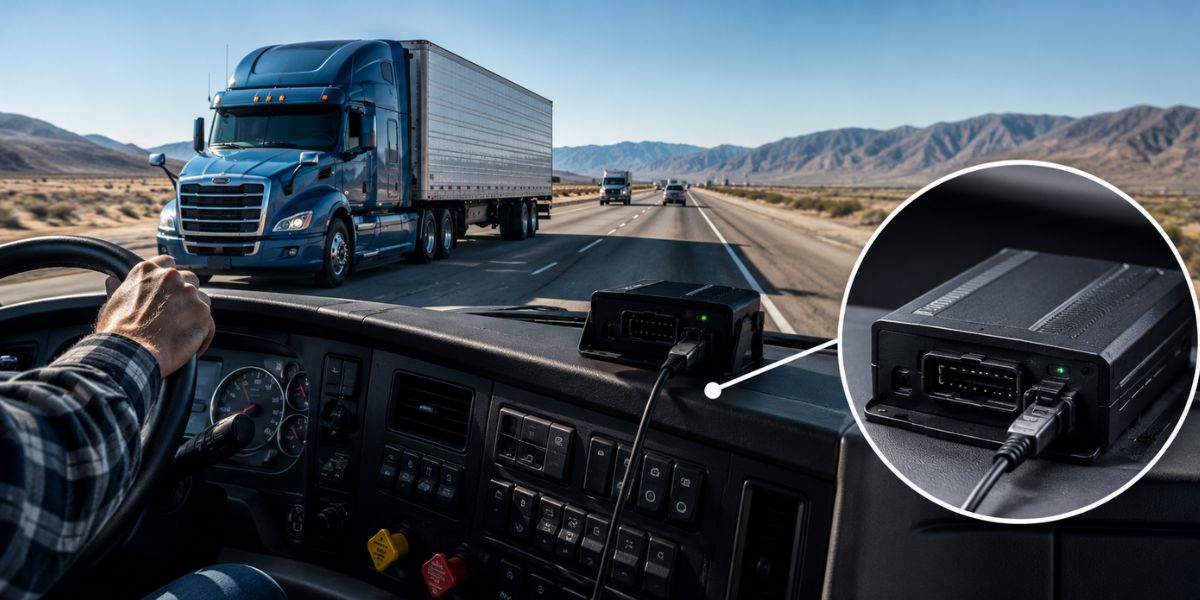
Electronic On-Board Recorder (EOBR) is a hardware device installed in commercial motor vehicles to capture driver activity and vehicle operation data. It supported Hours of Service (HOS) tracking under rules enforced by the Federal Motor Carrier Safety Administration (FMCSA).
Connected with the vehicle engine and onboard systems, an EOBR logged driving time, engine hours, mileage, movement, and duty status changes. Fleet operators used these records to verify driver logs, monitor compliance, and prepare for roadside inspections.
EOBRs helped move commercial fleets away from paper logbooks, but they did not provide the full automation or standardization later required by regulators. This gap became important as electronic logging rules evolved.
History of Electronic On-Board Recorder (EOBR)
Regulatory attention increased in 2011 after the FMCSA proposed requiring EOBRs for interstate commercial truck and bus companies.The proposal was expected to affect more than 500,000 carriers in the United States.
Mandatory use was first aimed at companies with poor compliance records, with implementation planned for June 2012. On August 26, 2011, the 7th U.S. Circuit Court of Appeals vacated and remanded the rule after a lawsuit from the Owner–Operator Independent Drivers Association (OOIDA).
EOBRs remained part of the HOS compliance discussion, yet they still required manual entry for non-driving duty status when a vehicle was not moving. Legal delays, manual-input gaps, and inconsistent standards eventually pushed the industry toward Electronic Logging Devices (ELDs) as the modern compliance standard.
Why Did the ELD Mandate Replace EOBRs?
The ELD Mandate made EOBRs outdated by changing electronic logging from basic recordkeeping into a regulated, standardized compliance system.
Compliance Standard
ELDs must meet FMCSA technical requirements and appear on the official ELD registry before fleets can use them for federal compliance. EOBRs were built under older expectations, so they could not satisfy the same rules for device certification, data consistency, and record control.
EOBR Gap
EOBRs helped digitize driver logs, but they still allowed too much variation in how duty status and vehicle activity were recorded. Non-driving work often required manual driver input, which weakened accuracy during Hours of Service (HOS) reviews.
AOBRD Phaseout
The ELD rule took effect on December 18, 2017, but fleets using grandfathered AOBRDs received extra time to transition. That grace period ended on December 16, 2019, pushing most regulated carriers away from older electronic logging systems.
Inspection Rules
ELD systems must support standardized log access and data transfer during roadside inspections. EOBR records were less uniform, making it harder for enforcement officers to review compliance data consistently across carriers.
Fleet Transition
The mandate forced fleets to replace legacy recorders, retrain drivers, and adopt systems built for audit-ready compliance. As a result, EOBRs became a historical step between paper logbooks and modern ELD-based fleet management.
What Is the Difference Between EOBR and ELD?
EOBRs and ELDs both track driver activity, but ELDs replaced EOBRs due to stricter compliance requirements and standardized enforcement.
| Comparison Point | EOBR | ELD |
| Full form | Electronic On-Board Recorder | Electronic Logging Device |
| Compliance status | Legacy electronic logging system | Current FMCSA compliance standard |
| Main purpose | Digitize driver logs and vehicle activity records | Automatically record Hours of Service and duty status data |
| Regulatory role | Used before modern ELD requirements | Required for most carriers maintaining Records of Duty Status |
| Device standard | No uniform federal standard | Must meet FMCSA technical specifications |
| FMCSA registry | Not required | Must be listed on FMCSA ELD registry |
| Engine connection | Partial or system-dependent | Mandatory engine synchronization |
| Duty status tracking | Manual input for non-driving status | Automated driving time with standardized logs |
| Data accuracy | Dependent on driver input and system design | Higher consistency through automation |
| Roadside inspection | Non-uniform data display and transfer | Standardized inspection and data transfer methods |
| Log edits | Less structured edit tracking | Mandatory edit logs with audit trail |
| Fleet usage | Mostly obsolete | Widely used for compliance and operations |
| Technology scope | Focused on log digitization | Integrated with telematics and fleet systems |
| Timeline | Used mainly before 2017 ELD rule, phased out by 2019 transition deadline | Mandatory from Dec 18, 2017, with full enforcement after Dec 16, 2019 transition period |
Final Thoughts
Electronic On-Board Recorder (EOBR) played an important role in moving the trucking industry from paper logs to digital recordkeeping. It helped fleets improve visibility into driver activity, even though it lacked the consistency required for long-term regulatory use.
Regulatory evolution through the ELD Mandate redefined how compliance systems should function across the industry. Standardization, automation, and inspection-ready data made Electronic Logging Devices (ELDs) the new foundation for Hours of Service (HOS) tracking.
Modern fleet operations now rely on ELD-based systems that combine compliance with telematics, reporting, and real-time monitoring. EOBR remains a transitional technology, but understanding its role helps explain how current fleet compliance systems evolved.
Frequently Asked Questions
1. Can EOBRs be upgraded to meet ELD requirements?
EOBRs cannot simply be upgraded unless they fully meet FMCSA ELD technical specifications. Most older systems require complete replacement with certified ELD devices.
2. Are EOBRs still allowed outside the United States?
Some regions may still use systems similar to EOBRs, but many countries rely on regulated devices like digital tachographs or ELD-style systems. Compliance rules vary depending on local transportation authorities.
3. Do ELDs track driver location at all times?
ELDs record location data at specific intervals, such as during duty status changes and driving events. They do not continuously track precise real-time location in the same way as full GPS tracking systems.
4. What happens if an ELD malfunctions during a trip?
Drivers must follow FMCSA guidelines, which allow temporary use of paper logs while the issue is resolved. The device typically needs to be repaired or replaced within a limited timeframe.
5. Are small fleet operators required to use ELDs?
Requirement depends on whether drivers must maintain Records of Duty Status (RODS) under HOS rules. Certain exemptions apply, such as short-haul operations or specific vehicle categories.
6. How do ELDs improve driver safety compared to EOBRs?
ELDs reduce fatigue-related risks by enforcing accurate driving limits and minimizing log manipulation. Automated tracking and alerts help drivers stay within legal limits and improve overall road safety.