

Key Takeaways
- A commercial roadside plan has to match the weight, cargo, and equipment of a Class 7 or Class 8 truck, so passenger-style coverage built for cars leaves a loaded rig exposed the moment it goes down.
- The U.S. vehicle roadside assistance market reached roughly $6.18 billion in 2025 and is projected to climb to about $9.3 billion by 2033, with towing standing as its single largest service segment, according to Grand View Research.
- The most expensive part of a breakdown is usually the downtime rather than the repair, because a stopped truck keeps running up ownership, driver, and fuel costs the entire time it waits for help.
- A single heavy-duty tow or a full recovery can cost more than an entire year of membership, which is why per-incident caps and mileage limits matter more than the monthly price.
- Fast response protects a driver’s remaining hours of service, so an operator that reaches the truck quickly can be the difference between finishing the load today and losing a second day to the same delivery.
What is commercial truck roadside assistance?
Commercial truck roadside assistance is the emergency help a fleet calls when a tractor, a trailer, or a straight truck can no longer keep rolling safely. A passenger roadside plan is built around a jump-start or a short tow for a light vehicle, but a commercial plan has to account for a combination that can weigh 40 tons, the freight riding inside it, and the specialized equipment it takes to move any of that off the road.
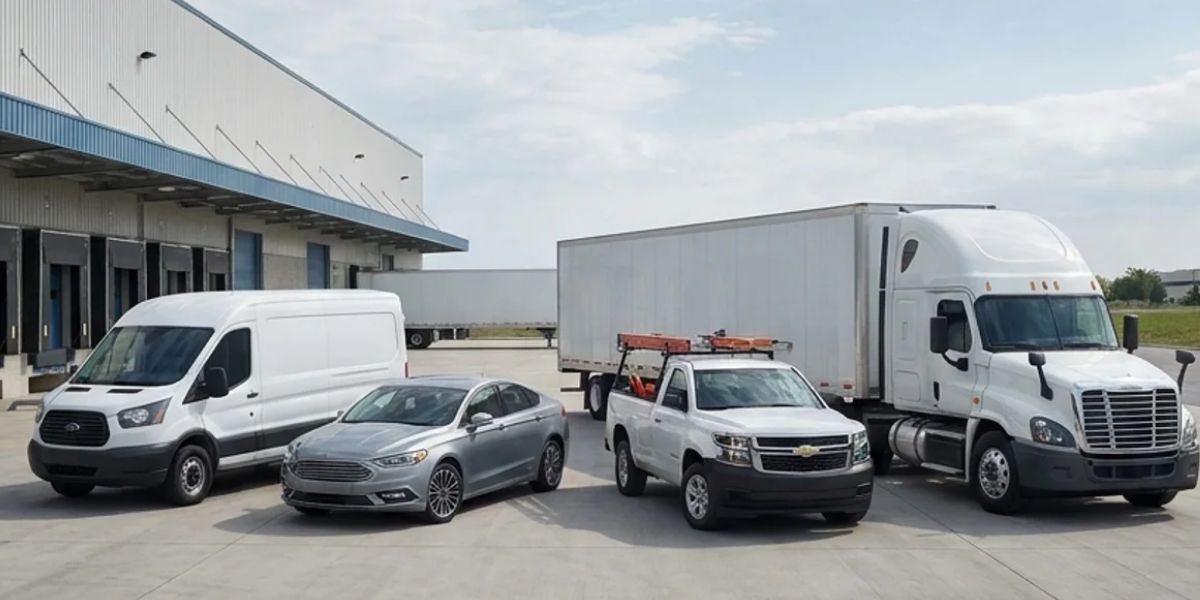
The clearest way to understand the gap is to look at vehicle class. Federal weight classes run from Class 1 through Class 8, and most freight trucks fall into Class 7, which covers vehicles from 26,001 to 33,000 pounds, or Class 8, which covers anything over 33,000 pounds. A light-duty wrecker simply cannot handle those weights, so the equipment, the technician’s training, and the response plan all have to scale up with the truck. Replacing a blown steer tire on a loaded Class 8 tractor calls for a different tire, rim, and technician than a box-truck flat, and none of that even touches the trailer yet.
Cargo raises the stakes even higher. Imagine a refrigerated trailer, known in the industry as a reefer, stranded on the shoulder at two in the morning with a shredded tire and a full load of produce. Getting the truck moving again is only half the job, because the shipment starts losing value the moment the reefer unit stops holding temperature. A plan that promises to “send the nearest tow truck” solves neither problem, and that is exactly why the coverage details deserve a careful read before you sign anything.
What should a commercial roadside plan actually cover?
Strong coverage follows the truck, the failure, and the cargo, rather than forcing a heavy combination into a one-size passenger template. Depending on what has gone wrong, a good plan either repairs the problem where the truck sits, protects the driver and the load until help arrives, or moves the unit to a shop that can finish the job properly.
Roadside triage and diagnosis
Before anyone is dispatched, the provider should collect the truck’s exact location, its vehicle class, the active warning lights, the air-pressure reading, any visible leaks, the position of the failed tire, and the status of the cargo. Those details are what determine whether a mobile mechanic, a tire technician, a heavy-duty wrecker, or a full recovery crew is the right first response.
Mobile repair on the shoulder
Many failures can be handled right where the truck stopped, including air-line leaks, cracked gladhand seals that connect the trailer air lines, worn belts, split coolant hoses, corroded battery cables, and minor electrical faults. More serious problems with the brakes, steering, suspension, or major fluid loss usually require a shop inspection, because attempting them on the roadside is neither safe nor reliable.
Commercial tire service
Tire size on its own tells the technician very little about what to bring. The axle position, the rim type, the load rating, the single or dual-wheel setup, and the loaded weight of the trailer all shape the correct response, which is why a steer-tire failure on a loaded Class 8 tractor is a completely different call than a trailer flat.
Battery and charging support
A truck that will not start could be dealing with drained batteries, corroded terminals, damaged cables, a weak starter, or a failing alternator. Jumping the engine back to life only helps when the charging system is healthy enough to keep the truck running once it is back on the highway, so the technician has to confirm the actual cause rather than just restarting it.
Fuel and fluid delivery
Emergency service often includes bringing diesel, diesel exhaust fluid known as DEF, coolant, or the correct grade of engine oil out to the truck. Sudden fluid loss still needs a proper inspection, because simply topping off the reservoir will never repair a split hose, a leaking seal, or a cracked radiator that caused the loss in the first place.
Heavy-duty towing
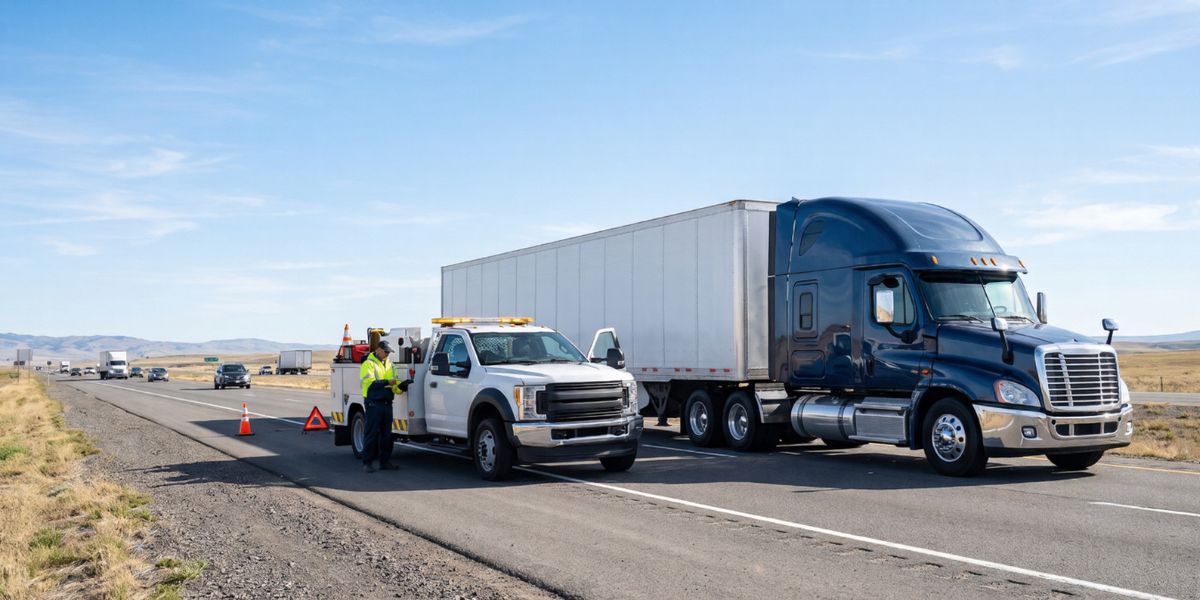
The type of wrecker you need depends on whether the tractor is moving on its own or still has the trailer attached. The combined weight, the axle condition, any driveline trouble, the ground clearance, and the intended repair destination all influence the tow setup, so accurate details up front prevent a second truck from having to be dispatched.
Recovery and winching
A rig that has slid into a ditch, jackknifed across the lanes, or rolled onto its side may need winching, a rotator crane, traffic control, cargo transfer, or spill cleanup. Recovery is treated as its own category because the labor, the machinery, and the pricing look nothing like a standard tow, and a plan that covers towing will not automatically cover recovery.
What should a driver and dispatcher do when a truck breaks down?
A breakdown resolves faster when the driver and the dispatcher follow the same sequence every time: make the scene safe, pin down the location, describe the failure, get the right help approved, and then track the response to the finish. The five steps below carry a fleet from the first hazard light all the way back to a truck that is running again.
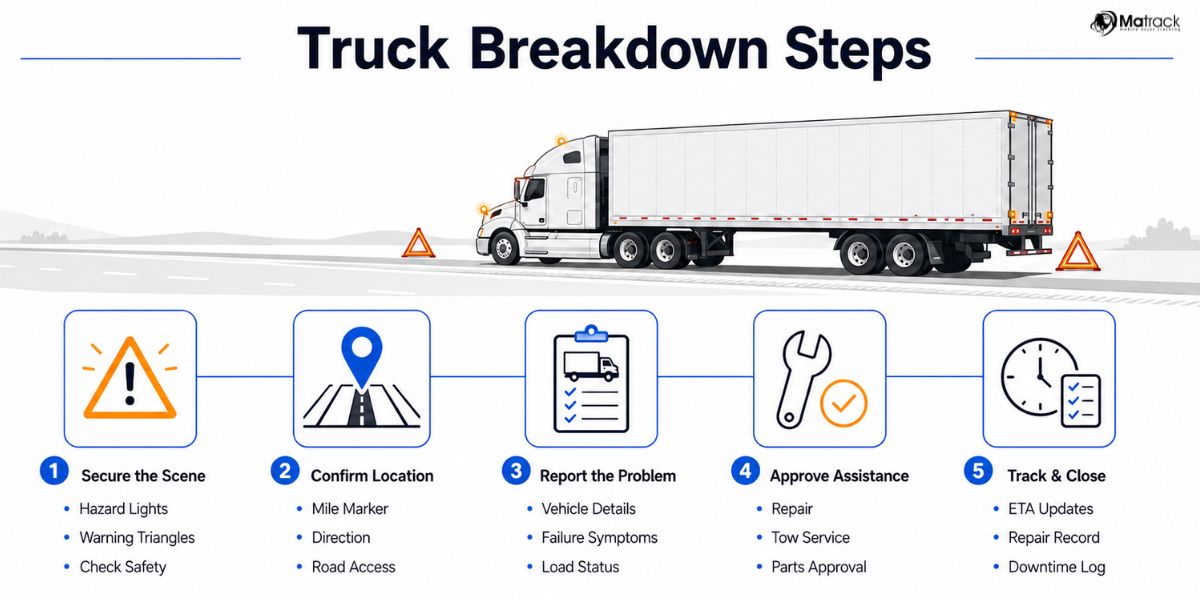
Step 1: Secure the scene.
Federal regulations spell out exactly what the driver must do here. Under 49 CFR 392.22, the driver has to activate the hazard warning flashers immediately and, within 10 minutes, place three warning devices on the road. On a normal two-way road, one triangle goes about 10 feet behind the truck on the traffic side, and the other two go roughly 100 feet out, while on a divided or one-way highway the devices shift to 10, 100, and 200 feet toward approaching traffic. Only after the scene is protected should the driver check for smoke, fluid leaks, tire debris, or a load that has shifted.
Step 2: Pin down the exact location.
Dispatch needs a precise position rather than a vague description like “somewhere on Interstate 40.” The direction of travel, the nearest mile marker, the closest exit, the shoulder access, and any blocked lanes are what allow the service unit to reach the correct side of the road on the first attempt instead of circling back.
Step 3: Describe the truck and the failure.
The tractor type, the trailer number, the axle configuration, the load status, the gross weight, and the position of the failed tire all change what should be dispatched. Clear symptoms save even more time, so a report such as “blown steer tire,” “low air pressure,” “coolant leaking behind the cab,” or “reefer temperature climbing” gives the technician a real starting point instead of a guessing game.
Step 4: Get the right help approved
Approval gaps keep disabled trucks parked far longer than the mechanical problem ever would. Everyone involved should already know who is authorized to approve parts, towing, after-hours labor, and recovery and up to what dollar amount so the technician is never left waiting on a phone call while the meter runs.
Step 5: Track the response and close the record.
The whole team should be working from a single timeline that includes the technician’s estimated arrival, the diagnosis, the repair progress, the tow destination, and the expected return to service. Before the incident is closed, the fleet should log the failure time, the roadside position, the work performed, the parts installed, the arrival time, the final cost, and the total downtime, because that record makes every future breakdown decision faster and better informed.
What does commercial truck roadside assistance really cost?
The first cost to understand is downtime, because it is the one that never shows up on an invoice. According to ATRI’s 2026 Analysis of the Operational Costs of Trucking, the industry-average cost to operate a truck reached a record $2.336 per mile in 2025, and repair and maintenance costs alone climbed 8.6% that year. A stalled truck is quietly burning through those fixed costs the entire time it waits, well before you add a missed delivery window or a detention charge from the receiver.
The pay-per-use towing bill lands directly on top of that downtime. A loaded Class 8 tow typically carries a hookup fee of $150 to $600 plus a per-mile rate of $4 to $15, and a 50-mile move of a loaded semi can clear $600 on its own, based on 2026 towing-rate surveys. When the job crosses into recovery, a rotator crane is often billed by the hour at roughly $500 to $800, and a rollover that requires cargo transfer or spill cleanup can easily run past $10,000.
A membership only softens those numbers if the fine print actually works in your favor. The terms below are the ones that quietly decide your real cost, so it pays to read each of them before you commit:
- Per-incident cap. Some plans pay only $500 or $1,000 toward a single breakdown, and a commercial tire, after-hours labor, and a heavy-duty tow can blow through that ceiling in one call. Confirm whether the cap applies to each truck separately or to the entire account at once.
- Tow mileage. Included towing distance often stops at 10, 25, or 50 miles, and every mile beyond that allowance is billed at the provider’s commercial rate, which climbs even higher for a loaded combination.
- Labor time. A plan might cover only 30, 60, or 90 minutes of technician labor, and diagnosis, travel, and waiting for authorization can consume that window before the actual repair even begins.
- Weight ceiling. Light-duty tiers stop at a stated gross vehicle weight, so a loaded Class 8 combination can fall completely outside the towing benefit unless the plan is written for heavy-duty equipment.
- Service count. The word “unlimited” usually means four or five uses per truck each year, or a single shared pool spread across the whole fleet, so it is worth confirming the real number.
- Parts allowance. Many memberships arrange for the technician but still leave you paying for the tire, battery, hose, fuel, or DEF, sometimes with only a small credit of $50 to $100 toward parts.
- Recovery trigger. Basic towing coverage ends the moment winching, a rotator, or a lane closure enters the job, and recovery carries its own hourly minimums that are separate from the tow.
The exclusions live in that same section of the contract. Trailer-only problems such as reefer faults, liftgate failures, trailer tires, and landing-gear repairs may require separate coverage; the tire labor rarely includes the tire itself, and service on nights, weekends, and holidays usually adds a premium of 20% to 50% on top of the standard call.
How should a fleet choose and evaluate a roadside provider?
The right way to judge a provider is by what happens from the first phone call to the truck’s return to service, not by how impressive the national coverage map looks. Dispatch speed matters, of course, but so do the network’s real reach, its heavy-duty capability, its arrival accuracy, and the amount of time that leaks away between each handoff.
Begin with the lanes your trucks actually run. Compare the density of qualified vendors along your freight corridors, mountain grades, ports, and border crossings, and check the average distance to the nearest heavy-duty technician, because a wide coverage area means very little when the closest qualified help is three hours away. Next, match the provider’s capability to your real equipment by asking which vendors can handle loaded Class 8 combinations, reefers, liftgates, and low-clearance units, and keep your truck specifications, tire sizes, and preferred tow points on file so dispatch never sends a light-duty unit to a job it cannot complete.
From there, look for hard evidence rather than promises. A few honest questions will tell you most of what you need to know before you commit:
- Will the provider share real ETA-accuracy data or only a quoted arrival window that it rarely meets?
- How often does the first truck actually fix the problem without needing a second visit or a reassignment to another vendor?
- What do the response times look like on nights, weekends, and rural routes, rather than only the overall average?
- Is there a live person who can authorize a decision on towing, parts, or recovery at three in the morning?
It also helps to break each real event into timestamps, from the moment it was reported through assigned, en route, arrived, diagnosed, approved, repaired, and returned. Comparing those intervals shows you whether the delay came from travel distance, missing parts, or a slow approval, so you can fix the actual bottleneck instead of blaming the entire wait on the “roadside.”
How do preventive maintenance and telematics cut roadside breakdowns?
Roadside recovery used to be nothing but muscle and rope. Ernest Holmes Sr. built one of the first mechanical tow trucks back in 1916 after spending several hours dragging a wrecked car out of a creek by hand, and that single invention is essentially where the modern towing industry was born. The heavy lifting has never gone away, but the real advantage today is information, and that is exactly where preventive maintenance and telematics do their most valuable work.
Preventive maintenance will never stop every puncture or every battery that dies in a cold snap, and it is not designed to. Its real value is catching the failures a fleet can actually control, such as weak batteries, recurring fault codes, worn tires, and small leaks, long before they leave a driver stranded on the shoulder.
Four habits move the largest share of breakdowns off the roadside. The first is closing the loop on every driver vehicle inspection report, known as a DVIR, by assigning each reported brake, air, or steering note a clear owner and a completion date. The second is reading patterns in the fault codes instead of reacting to a single alert, because the same code appearing across several trips points to a developing problem rather than a one-time glitch. The third is servicing each truck by its actual duty cycle rather than a flat mileage number, since a city delivery truck and a long-haul reefer wear down on completely different schedules. The fourth is grouping failure history by individual truck, so a pattern of repeat jump-starts or tire calls leads you straight to the root cause.
Telematics is what turns all of that maintenance data into a faster roadside response. A GPS feed and an electronic logging device, or ELD, let the provider see a truck’s exact position, route, and status the moment the driver calls, which removes the “which side of the highway are you on” delay and helps send the right technician, tire, or tow on the very first trip. Fault-code data pushes that even further by flagging a developing engine derate or coolant issue while the truck is still moving, which sometimes gives the fleet enough warning to reach a shop instead of a ditch.
Roadside assistance vs. breakdown management vs. OEM programs: Which does a fleet need?
The right option depends on whether the operation needs basic emergency access, full incident handling, or manufacturer-backed repairs.
| Option | How it works | Covers | Main limits | Best fit |
| Roadside assistance | Dispatches a local vendor through a membership network. | Towing, jump-starts, fuel delivery, lockouts, tire labor, minor repairs, and limited winching. | Mileage caps, weight restrictions, parts charges, recovery fees, and weaker rural availability. | Owner-operators, local carriers, and small fleets. |
| Breakdown management | A case manager handles vendor selection, approvals, updates, and billing. | Towing, repair coordination, shop placement, parts approval, ETA tracking, and invoice review. | Higher fees and less control over vendor choice. | Regional and national carriers with mixed equipment. |
| OEM roadside program | The manufacturer routes eligible repairs through its dealer network. | Warranty work, diagnostics, genuine parts, technical guidance, and qualifying towing. | Usually limited to the tractor brand, warranty terms, and approved dealers. Trailers and reefer equipment may not qualify. | Fleets with newer trucks from one manufacturer. |
| Combined approach | OEM benefits handle eligible tractor repairs, while another program covers remaining needs. | Warranty work, trailer issues, tire service, recovery, and out-of-warranty repairs. | Overlapping benefits can create duplicate costs. | Mixed-brand and long-haul fleets. |
Small fleets may only need roadside assistance plus existing OEM benefits. Larger carriers often benefit more from breakdown management.
Frequently asked questions
Does a truck’s 14-hour clock keep running during a breakdown?
The clock does keep running, because the FMCSA 14-hour on-duty window counts continuously and does not pause while a driver waits on a tow. A slow roadside response can therefore consume a driver’s remaining legal hours and push the delivery into a second day.
Does commercial roadside assistance cover the trailer or only the tractor?
Many plans cover the power unit and treat the trailer as a separate item, which can leave reefer faults, liftgate failures, trailer tires, and landing-gear repairs uncovered. The safest move is to get trailer coverage confirmed in writing before you ever rely on it.
Is commercial roadside assistance the same as towing insurance?
The two are not the same thing, because roadside assistance dispatches and often discounts emergency service, while towing or physical-damage coverage on your commercial auto policy may reimburse costs after the fact. Depending on how each is written, they can overlap or leave a gap, so it is worth reviewing both together.
Who pays when a tow goes past the covered mileage?
The fleet covers the overage, since the included towing distance usually stops at a set number of miles. The extra mileage, along with any tolls and the cost of moving the truck to a preferred shop, is billed at the provider’s commercial rate.
Does a roadside plan keep a loaded reefer cold during a breakdown?
Standard roadside service does not protect the load by default, because it is aimed at the truck rather than the cargo. Keeping temperature-sensitive freight cold may require reefer-specific support or a cargo-transfer plan written directly into your coverage.