


What Is a TMS System?
A transportation management system (TMS) is a software platform used to plan, execute, and monitor goods movement across logistics operations. Businesses use a TMS to choose carriers, build shipping plans, and track deliveries with accuracy.
Automation reduces manual tasks and lowers the chance of freight management errors. Integration with ERP and warehouse management systems supports smooth data exchange across supply chain operations.
Shipment visibility helps companies track transportation activity and manage costs from origin to delivery. Reliable control over freight operations makes a TMS important for businesses that depend on smooth logistics.
How Does a Transportation Management System (TMS) Work?
A transportation management system works by managing freight through planning, execution, and optimization stages.
- Shipment Planning: Order, route, and carrier data enter the system to prepare shipments based on cost, distance, and delivery requirements.
- Carrier Selection: Comparison tools help businesses review carrier rates, service quality, and transit times before making shipping decisions.
- Route Optimization: Route planning functions identify efficient delivery paths that reduce delays, fuel use, and transportation expenses.
- Load Execution: Freight movement begins with shipment booking, document creation, and coordination across transportation networks.
- Real-Time Tracking: Live shipment updates help logistics teams monitor progress and respond quickly to disruptions or schedule changes.
- Performance Analysis: Reporting tools evaluate carrier results, route performance, and freight spend to improve future transportation decisions.
What Features Does a Transportation Management System (TMS) Include?
Key features in a TMS support freight planning, carrier coordination, shipment visibility, cost control, and logistics reporting within one platform.
Route Planning
Route planning helps businesses decide how goods should move from origin to destination based on distance, delivery schedules, and shipment requirements. Well-planned routes reduce delays, support timely deliveries, and help lower transportation expenses.
Carrier Management
Carrier management features allow logistics teams to store carrier details, compare service options, and review freight rates before assigning a shipment. Access to this information helps businesses choose carriers that match delivery needs, service expectations, and budget limits.
Load Optimization
Load optimization improves how freight is arranged across available vehicle space and transport capacity. Load planning reduces unused space, supports smoother shipment movement, and helps control freight costs.
Shipment Tracking
Shipment tracking shows freight location during transit and how delivery progress changes over time. Live updates allow teams to monitor schedules, respond to disruptions, and maintain visibility across transportation operations.
Freight Auditing
Freight auditing reviews shipping charges and compares them with planned transportation costs. Accurate cost checks help businesses identify billing issues and maintain control over freight spending.
Document Management
Document management keeps shipping records, invoices, transport files, and delivery documents within the system for day-to-day use. Fast access to these records helps teams handle communication, verification, and shipment processing with fewer delays.
Analytics and Reporting
Analytics and reporting measure freight spend, delivery performance, carrier results, and route performance. Information from these reports helps businesses identify patterns, review outcomes, and improve future transportation decisions.
Integration Support
Integration support allows TMS software to work with ERP, WMS, and other logistics platforms used across the supply chain. Data shared between systems helps transportation activity stay aligned with orders, inventory, and fulfillment operations.
What Are the Main Types of Transportation Management Systems?
Different types of TMS platforms vary based on deployment method and how they fit within logistics or enterprise systems.
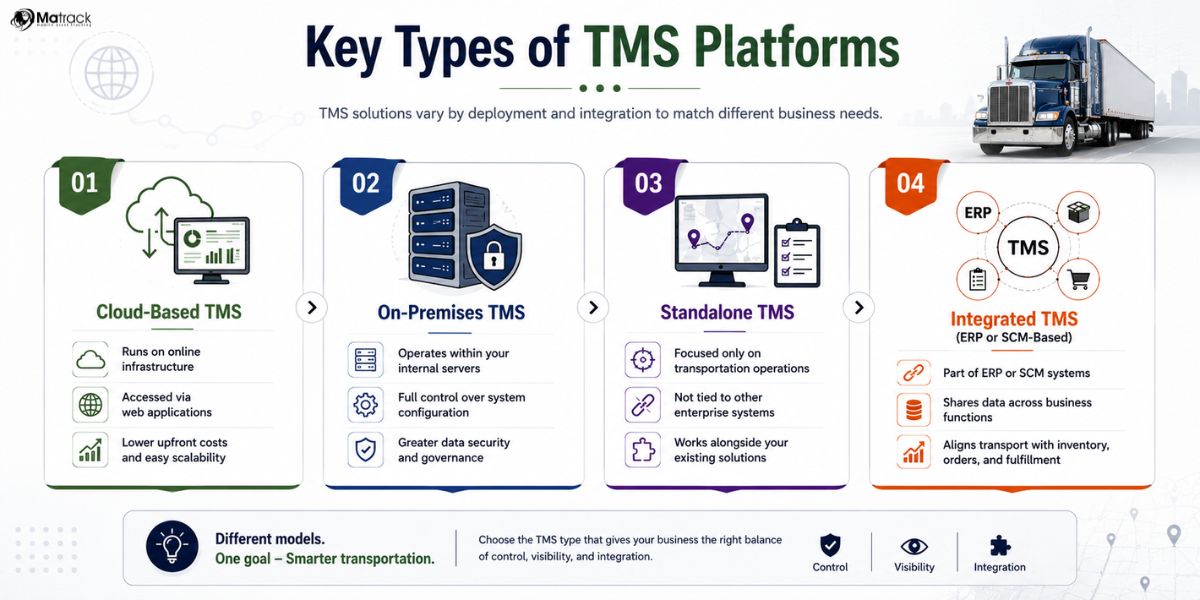
1. Cloud-Based TMS
Cloud-based TMS platforms run on online infrastructure and are accessed through web applications. Businesses prefer this model for faster setup, lower upfront costs, and the ability to scale without managing internal systems.
2. On-Premises TMS
On-premises TMS software operates within a company’s internal servers and IT environment. Organizations choose this option when higher control over system configuration and data handling is required.
3. Standalone TMS
Standalone TMS solutions focus only on transportation operations without being part of a larger enterprise suite. Businesses use this type alongside existing systems that handle other supply chain functions.
4. Integrated TMS (ERP or SCM-Based)
Integrated TMS platforms function as part of ERP or supply chain management systems. Shared system data helps align transportation activities with inventory, order processing, and fulfillment workflows.
What Are the Benefits of Using a Transportation Management System?
Benefits of a TMS include improved cost control, shipment visibility, smoother operations, and stronger logistics performance.
Cost Reduction
Improved carrier selection, route planning, and load optimization help reduce overall freight expenses. Lower operational costs result from minimizing manual errors and avoiding inefficient transportation decisions.
Shipment Visibility
Real-time tracking provides updates on shipment location and delivery progress. Clear visibility helps logistics teams respond quickly to delays and maintain control over freight movement.
Process Automation
Automation handles tasks such as shipment booking, document generation, and communication with carriers. Reduced manual effort leads to fewer errors and smoother logistics operations.
Carrier Performance Management
Data allows businesses to evaluate carriers based on delivery time, service quality, and cost performance. Informed decisions improve service reliability and strengthen carrier relationships.
Delivery Reliability
Optimized routes and structured planning improve delivery timelines and keep outcomes stable. Reliable transportation results support customer satisfaction and reduce missed delivery commitments.
Freight Cost Control
Detailed cost tracking helps businesses monitor spending across shipments and identify areas for savings. Financial visibility supports long-term transportation planning.
Operational Efficiency
Streamlined workflows reduce delays in planning, execution, and reporting processes. Faster operations improve coordination across logistics teams and systems.
Scalability
Flexible systems support increasing shipment volumes without disrupting existing workflows. Operational growth stays manageable with stable transportation processes.
What Are the Common Use Cases of a Transportation Management System?
Common use cases of a TMS focus on improving freight coordination, handling shipment complexity, and maintaining control over transportation operations across different business scenarios.
Inbound Freight Management
Inbound freight management controls shipments from suppliers to warehouses or production units. Timely coordination helps maintain inventory flow and prevents supply delays.
Outbound Shipment Management
Outbound shipment management handles deliveries from warehouses to customers or distribution centers. Planned dispatch improves delivery timelines and reduces missed shipments.
Multimodal Transportation Handling
Multimodal transportation involves moving goods across different transport types such as road, rail, air, or sea. Coordinated planning helps manage transitions between modes without delays.
International Shipping Operations
International shipping requires handling customs, documentation, and regulatory processes across borders. Proper management helps avoid compliance issues and shipment hold-ups.
E-commerce and Retail Fulfillment
E-commerce and retail businesses use TMS platforms to manage frequent shipments and fast delivery cycles. Routing and tracking support consistent order fulfillment.
Carrier Network Coordination
Carrier network coordination involves managing multiple transport providers across regions. Structured carrier handling improves service quality and supports better freight planning.
How Does a Transportation Management System Integrate with ERP, WMS, and SCM?
Integration with ERP, WMS, and SCM systems helps transportation activities stay aligned with orders, inventory, warehouse tasks, and supply chain planning.
| System | Integration Purpose | Data Shared | Business Benefit |
| ERP | Connects transportation with business and financial processes | Orders, invoices, billing details, customer records | Helps manage freight costs, order flow, and financial accuracy |
| WMS | Links transportation planning with warehouse operations | Inventory status, picking data, packing updates, shipment readiness | Supports timely dispatch and smoother warehouse coordination |
| SCM | Aligns transportation with wider supply chain activities | Procurement data, production schedules, delivery plans, supply updates | Improves visibility across supply chain operations |
| Order Management System | Keeps shipment planning aligned with customer orders | Order details, delivery timelines, item quantities, destination data | Reduces shipment errors and supports accurate delivery planning |
| Inventory System | Matches transportation activity with stock availability | Stock levels, warehouse location, replenishment updates | Prevents delays caused by inventory mismatch |
| Carrier Platform / API | Exchanges shipment and carrier data across transport networks | Carrier rates, shipment status, tracking updates, transit schedules | Improves tracking, carrier coordination, and transport execution |
What Should Businesses Consider Before Choosing a Transportation Management System?
Choosing a TMS depends on how well the system fits transportation needs, operational scale, and existing logistics processes.
Business Requirements
Business requirements define how the system will support daily transportation activities. Shipment volume, delivery regions, and transport complexity influence the type of solution needed.
Deployment Model
Deployment model selection depends on preference for cloud-based access or internal system control. Cloud solutions offer flexibility, while on-premises setups provide greater control over infrastructure.
Integration Capabilities
Integration capabilities determine how effectively the system works with ERP, WMS, and other logistics platforms. Smooth data flow supports consistent operations and reduces delays.
Ease of Use
Ease of use affects how quickly teams adopt and operate the platform. Simple interfaces reduce training time and improve workflow speed.
Cost Structure
Cost structure includes software pricing, setup expenses, maintenance, and long-term operational costs. Proper evaluation helps businesses plan budgets more accurately.
Scalability
Scalability ensures the system can support growth in shipment volume and operational complexity. Flexible platforms allow expansion without disrupting existing processes.
Support and Maintenance
Support and maintenance services help resolve technical issues and keep the system running smoothly. Reliable assistance reduces downtime and improves overall system performance.
How Matrack Fleet Management Adds Benefits for TMS in Trucking
Matrack fleet management strengthens a Transportation Management System through precise GPS tracking and real-time telematics data. Trucking companies gain accurate visibility into vehicle location, speed, and route progress.
Driver hours are recorded automatically through the Matrack ELD device, supporting regulatory compliance and improving scheduling through direct TMS integration.
On-road activity is captured through the Matrack fleet dash cam, helping resolve disputes quickly and adding an extra layer of safety. Combined tools provide stronger visibility, lower costs, and tighter control over daily transportation tasks.
Frequently Asked Questions
What is the main purpose of a TMS?
Primary purpose of a TMS is to help businesses plan, execute, and monitor movement of goods across transportation networks. Control over carriers, routes, and shipment progress allows logistics teams to manage freight with greater precision.
Is a TMS only useful for large companies?
Use of TMS software is not limited to large enterprises. Small and mid-sized businesses also adopt these platforms to improve shipment visibility, reduce manual work, and manage transportation processes with more structure.
What is the difference between TMS and WMS?
TMS focuses on transportation activities such as routing, carrier selection, shipment execution, and freight tracking. WMS supports warehouse operations such as inventory storage, picking, packing, and order handling before goods move into transit.
Can a TMS handle international shipping?
Many TMS platforms support international shipping through tools for documentation, compliance, and cross-border freight coordination. Support for these activities helps businesses manage global transportation with fewer operational disruptions.
How much does TMS software cost?
TMS software cost depends on vendor, features, deployment model, and business size. Entry-level solutions may start around $99 per user per month, while larger enterprise platforms usually follow custom pricing based on shipment volume, integrations, and operational requirements.
Does a TMS improve delivery performance?
Improved delivery performance is one of the main reasons businesses invest in TMS software. Route planning, real-time tracking, and stronger carrier coordination help reduce delays and support more reliable shipment execution.