


Driving fatigue can be reduced by getting 7–9 hours of sleep, taking regular breaks, staying hydrated, and using fatigue detection technology to maintain alertness. Practical steps like avoiding peak sleep hours, using power naps, and planning routes help prevent drowsy driving and reduce crash risk.
Sleep deprivation, circadian rhythm disruption, long driving hours, and poor habits like heavy meals or dehydration contribute to driver fatigue. Warning signs include yawning, slow reaction time, reduced focus, and behaviors such as lane drifting or missed exits.
Prevention strategies combine healthy driving habits with modern safety systems such as ADAS and driver monitoring technology. Applying these methods before and during trips helps maintain consistent alertness and improves overall road safety.
What Is Driving Fatigue?
Driving fatigue is a condition where physical and mental exhaustion reduces a driver’s alertness and ability to operate a vehicle safely. It develops when the body and brain lack sufficient rest, leading to decreased focus and slower response to road situations.
Mental fatigue affects concentration, decision-making, and reaction time, making it harder to process traffic conditions accurately. Physical exhaustion adds to this by causing discomfort, reduced coordination, and difficulty maintaining control of the vehicle.
Severe cases involve drowsy driving, where the risk of falling asleep at the wheel becomes high due to prolonged wakefulness or circadian rhythm disruption. Such fatigue-related impairment significantly increases the likelihood of errors and unsafe driving behavior.
What Causes Driving Fatigue During Long or Daily Drives?
Multiple biological, behavioral, and environmental factors contribute to driving fatigue, primarily linked to lack of sleep, disrupted body rhythms, and prolonged mental effort behind the wheel.
- Sleep deprivation: Insufficient or poor-quality sleep before driving directly reduces cognitive performance, weakens attention span, and significantly slows reaction time during critical moments on the road.
- Circadian rhythm disruption: Natural dips in the body’s biological clock, especially during late-night hours and early afternoon periods, lower alertness levels and increase the likelihood of drowsiness while driving.
- Prolonged driving duration: Extended hours behind the wheel without adequate breaks lead to cumulative mental fatigue and physical strain, making it harder to maintain consistent focus and control.
- Monotonous road conditions: Repetitive highway environments with minimal variation reduce sensory stimulation, causing the brain to disengage and accelerating the onset of fatigue.
- Heavy meals and poor nutrition: Consuming large or unbalanced meals before driving diverts energy toward digestion, leading to sluggishness and decreased mental sharpness.
- Dehydration effects: Low fluid intake impacts brain function, causing tiredness, and slower information processing during driving.
- Medication and substance influence: Sedatives, certain prescription drugs, and alcohol impair alertness levels and increase the risk of drowsy driving even in small amounts.
What Are the Warning Signs of Driver Fatigue?
Warning signs of driver fatigue appear through physical strain, mental slowdown, and noticeable changes in driving behavior that signal declining alertness on the road.
- Physical indicators: Heavy eyelids, frequent yawning, and difficulty keeping eyes open suggest the body is struggling to maintain wakefulness. Blurred vision and eye strain further affect the ability to track road movement and surrounding vehicles.
- Mental slowdown: Reaction time becomes slower, focus weakens, and decision-making takes longer during changing traffic conditions. Information processing loses sharpness, increasing the chances of delayed or incorrect responses.
- Driving behavior shifts: Lane drifting, inconsistent speed control, and missing exits or signals reflect reduced awareness and control behind the wheel. Such patterns often develop before more severe fatigue-related impairment.
- Microsleep episodes: Brief, uncontrollable lapses in consciousness can occur without awareness, especially during long or monotonous drives. Even a few seconds of inattention at high speed greatly increases accident risk.
How To Reduce Driving Fatigue On The Road?
Reducing fatigue during driving requires managing sleep quality, biological timing, physical condition, and environmental factors so mental clarity and reaction ability remain stable throughout the journey.
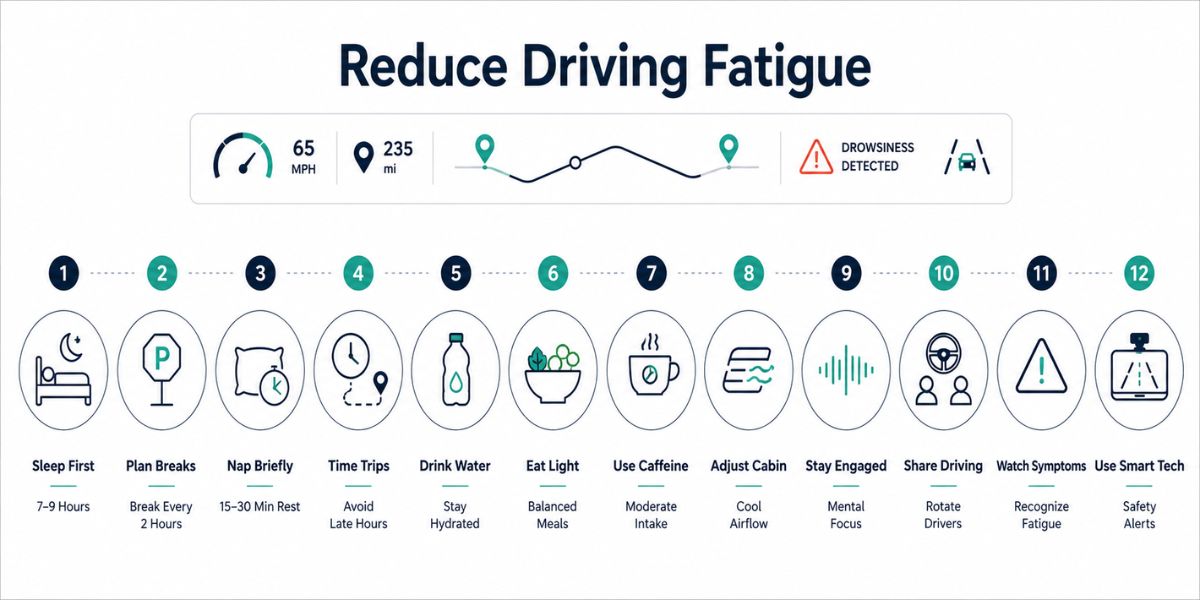
1. Sleep First
Adequate sleep before travel directly supports cognitive processing, allowing faster interpretation of speed, distance, and movement across changing road conditions. Research from CDC indicates adults require 7 to 9 hours of sleep, and falling below this range weakens attention, memory recall, and response accuracy even before visible tiredness appears.
Fatigue rarely arrives as sudden exhaustion; instead, awareness declines gradually through subtle lapses in concentration and slower decision-making. Beginning a drive with sufficient rest creates a reserve of alertness that helps sustain performance during demanding or unpredictable situations.
2. Plan Breaks
Continuous driving creates cumulative mental strain, especially during long highway stretches where sensory input remains repetitive and low in variation. Over time, sustained focus becomes harder to maintain as neural fatigue builds through constant attention demands.
Guidance from OSHA recommends breaks roughly every two hours, not as a reaction to tiredness but as a structured preventive measure. Physical movement, posture change, and brief disengagement from driving conditions restore mental clarity and reduce accumulated strain.
3. Nap Briefly
Short-duration sleep provides rapid recovery for declining alertness once early fatigue signals begin to appear. A controlled nap lasting 15–30 minutes improves cognitive sharpness, reaction timing, and overall situational awareness during continued travel.
Ignoring initial signs of drowsiness allows fatigue to deepen, making recovery more difficult and increasing risk during later stages of driving. Timely rest interrupts that progression and stabilizes mental performance before impairment becomes severe.
4. Time Trips
Human alertness follows circadian rhythms that naturally fluctuate across a 24-hour cycle, influencing energy levels and cognitive readiness. Driving during biological low points such as late-night hours or mid-afternoon periods increases likelihood of reduced vigilance and slower reactions.
Planning journeys around periods of natural wakefulness supports longer-lasting focus without relying heavily on external stimulation. Alignment with biological timing allows mental resources to remain steady across extended distances.
5. Drink Water
Hydration supports neurological function by maintaining proper blood flow and oxygen delivery to brain tissue, both essential for sustained concentration. Even mild dehydration can impair attention span, increase fatigue perception, and reduce decision-making efficiency.
Regular water intake helps preserve mental clarity throughout long drives, especially under conditions involving heat or prolonged sitting. Maintaining fluid balance prevents gradual cognitive decline that often goes unnoticed until performance drops.
6. Eat Light
Nutritional intake influences energy allocation within the body, particularly during activities requiring sustained focus such as driving. Heavy meals shift metabolic resources toward digestion, often resulting in reduced alertness and increased sluggishness.
Lighter, balanced meals help maintain steady energy levels, supporting stable brain function and avoiding sudden drops in attention. Careful portion control contributes to improved focus during extended travel periods.
7. Use Caffeine
Caffeine stimulates central nervous system activity, temporarily improving alertness and reaction speed when fatigue begins to emerge. Strategic use during early stages of tiredness can help maintain focus for a limited duration.
Dependence on repeated intake may lead to fluctuating energy levels rather than steady alertness, reducing effectiveness over time. Combining moderate caffeine use with rest produces more reliable cognitive performance.
8. Adjust Cabin
The driving environment plays a significant role in fatigue development by influencing physical comfort and sensory stimulation. Warm, stagnant air can accelerate drowsiness by reducing physiological alertness and increasing relaxation.
Improved airflow, cooler temperature settings, and proper seating posture help maintain physical engagement and reduce strain during long drives. Environmental adjustments support wakefulness without requiring extra effort.
9. Stay Engaged
Monotonous driving conditions, especially on long highways, reduce sensory input and can lead to gradual disengagement of attention. Mental stimulation helps maintain cognitive activity and prevents passive driving behavior.
Carefully selected audio content or conversation can support awareness without interfering with focus on road conditions. Maintaining balance ensures engagement enhances alertness rather than becoming a distraction.
10. Share Driving
Extended driving duration increases both physical fatigue and cognitive load, particularly when responsibility remains with a single driver. Distributing driving tasks allows recovery periods that help maintain alertness.
Switching drivers before noticeable exhaustion develops prevents performance decline and reduces cumulative strain. Shared responsibility improves overall safety and endurance during long-distance travel.
11. Watch Symptoms
Fatigue often reveals itself through subtle behavioral and cognitive changes rather than obvious signs of exhaustion. Indicators such as drifting attention, repeated yawning, missed visual cues, or difficulty recalling recent moments signal declining alertness.
OSHA reports approximately 37% of adults sleep less than 7 hours, highlighting widespread vulnerability to fatigue-related impairment. Recognizing and responding to these signals early helps prevent escalation into dangerous driving conditions.
12. Use Smart Tech
Modern safety systems analyze driving patterns to detect irregular behavior such as lane deviation, delayed reactions, or speed control. A fleet dash cam with ADAS alerts provides real-time feedback that supports driver awareness during demanding or repetitive driving conditions.
Human limitations remain a critical factor regardless of technological support. NHTSA estimated 36,640 traffic fatalities in 2025, emphasizing how proper rest, structured breaks, and intelligent safety systems must work together to reduce risk on modern roads.
How Does Driving Fatigue Affect Reaction Time and Safety?
Fatigue slows reaction time, weakens decision-making ability, and lowers overall driving performance, creating conditions where even minor delays can lead to serious accidents.
- Delayed response speed: Lower alertness causes slower reactions to sudden events such as braking vehicles, obstacles, or traffic signals. Even a one-second delay at high speed significantly increases stopping distance.
- Impaired judgment: Mental exhaustion affects risk evaluation and decision-making, making it harder to accurately judge distance, speed, and road conditions. Errors become more frequent in complex traffic situations.
- Weakened coordination: Physical tiredness impacts steering control and braking precision, leading to vehicle handling. Fine motor control becomes less reliable over time.
- Diminished vigilance: Sustained attention drops gradually, making it harder to continuously track surroundings. Important cues like lane markings, signals, or pedestrian movement may be missed.
- Microsleep danger: Brief lapses in consciousness can occur without warning, completely removing driver control for a few seconds. At highway speeds, this sharply increases crash severity and risk.
How Do Matrack AI Fleet Dash Cam Help Prevent Driving Fatigue?
Matrack AI Fleet Dash Cam helps prevent driving fatigue by detecting signs of distraction, drowsiness, and reduced attention in real time, allowing drivers to correct behavior before risk increases. AI-powered monitoring tracks eye movement, driving patterns, and in-cab activity to identify fatigue-related signals early and trigger immediate alerts.
Instant in-cab alerts guide drivers to refocus when lane drift, delayed reactions, or loss of attention occurs during long or repetitive routes. ADAS features monitor following distance, lane position, and collision risk, helping drivers respond quickly and maintain safer control under fatigue conditions.
Cloud-based video analysis and real-time tracking provide visibility into driver behavior, allowing fleet managers to review fatigue events and improve driving habits over time. Combined insights from GPS data, event recording, and AI detection support proactive decisions that reduce fatigue-related incidents and improve overall road safety.