

What Does PTO Mean on a Truck?
PTO stands for Power Take-Off, a mechanism connected to a vehicle’s driveline that operates external machinery. Commercial vehicles rely on this unit to run dump beds, compressors, winches, pumps, and lifting equipment without separate motors.
Construction fleets, towing vehicles, agricultural machinery, and utility rigs use driveline-powered attachments during field operations. Engine rotation moves through gears inside the assembly, allowing connected machinery to receive mechanical or hydraulic energy.
How Does a Truck PTO Work?
Engine rotation travels through the driveline and enters the Power Take-Off unit, where motion gets redirected toward external machinery.
- Drive entry: Internal contact with the gearbox transfers spinning motion into the unit. Energy begins moving away from the primary drive path toward auxiliary output.
- Power routing: Motion shifts through internal components and reaches the output side. Connected machinery receives usable energy without relying on a separate motor.
- Energy conversion: Pump-driven setups convert spinning motion into pressurized fluid. Cylinders and motors use that pressure for lifting, pushing, or rotating actions.
- Task execution: External units perform work once energy reaches them. Dump beds lift, winches pull, and compressors generate airflow based on application needs.
- Speed balance: Output rate changes depending on internal ratios and load demand. Stable delivery prevents overheating, strain, and uneven performance.
What Equipment Does a PTO Power on a Truck?
Power Take-Off assemblies operate auxiliary machinery by transferring engine-driven rotational force toward mounted work attachments.
- Dump beds: Hydraulic lifting mechanisms raise construction material during unloading operations. Gravel, sand, demolition debris, and soil transport frequently depend on this setup.
- Tow winches: Recovery vehicles pull disabled automobiles using cable-driven pulling assemblies. Rotational movement supplies steady pulling force during roadside recovery work.
- Air compressors: Pneumatic service tools receive compressed airflow from compressor-driven assemblies mounted on utility vehicles. Field repair crews use these systems during maintenance and roadside servicing.
- Vacuum pumps: Industrial cleaning and waste-handling vehicles remove liquid, sludge, or debris through suction-based pumping assemblies. Continuous rotational movement keeps collection processes active during operation.
- Crane mechanisms: Utility and construction fleets lift heavy materials using hydraulic boom assemblies. Controlled movement supports elevated repair work, loading operations, and infrastructure maintenance.
- Concrete mixers: Drum rotation stays active throughout transport to prevent material hardening before delivery. Continuous movement keeps cement evenly mixed during long-distance hauling.
What Are the Main Components of a Truck PTO System?
Engine-driven motion passes through several connected parts before reaching mounted machinery, with each component shaping how energy gets transferred, converted, and used.
Transmission Interface
Energy enters through a mounting point connected to the gearbox. This entry point redirects motion away from the main drive path and toward auxiliary output.
Internal Gear Set
Spinning elements inside the unit carry motion forward toward the output side. Ratio selection influences speed, torque, and how attached machinery responds under load.
Output Shaft
Motion exits through a rotating shaft connected to external units. Pumps, winches, and compressors rely on this stage to receive usable energy.
Hydraulic Pump
Pump-driven setups convert spinning motion into pressurized fluid. That pressure powers lifting, pushing, or compacting actions across different applications.
Fluid Pathway
Pressurized liquid travels through hoses, fittings, and directional channels. Flow direction determines how cylinders or motors perform specific tasks.
Engagement Mechanism
Activation begins through manual input, air pressure, or electronic signals. Smooth transition into operation prevents sudden load impact on connected parts.
Lubrication and Sealing
Moving surfaces stay protected through continuous lubrication. Sealed pathways keep contaminants out and maintain internal efficiency during extended use.
What Are the Different Types of PTOs on Trucks?
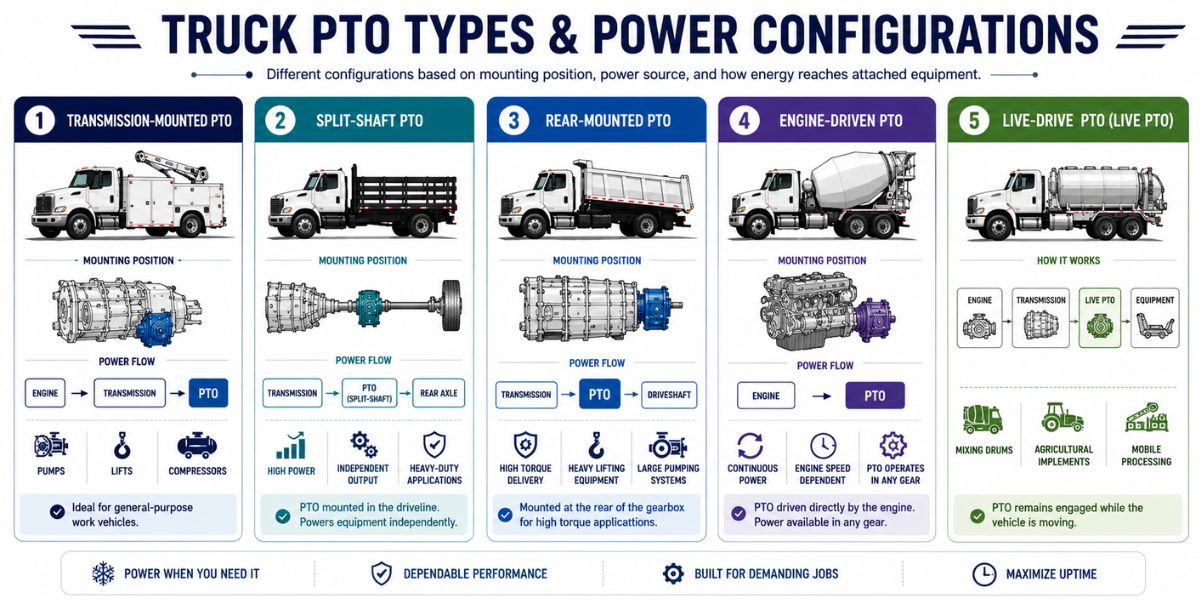
Different configurations exist based on mounting position, power source, and how energy reaches attached machinery during operation.
Transmission-Mounted Units
Installation takes place on a side or bottom opening of the gearbox. This setup suits general-purpose work vehicles where pumps, lifts, or compressors need consistent output during stationary tasks.
Split-Shaft Units
Placement occurs along the driveline between the gearbox and rear axle. Power gets redirected externally, making it suitable for high-demand applications that require independent output.
Rear-Mounted Units
Positioning at the rear of the gearbox supports higher torque delivery. Heavy-duty lifting assets and large pumping setups depend on this layout for demanding workloads.
Engine-Driven Units
Connection links directly to the engine rather than the gearbox. Continuous motion remains available regardless of gear selection, supporting applications that require uninterrupted operation.
Live Output Systems
Output remains active even while the vehicle moves. Mixing drums, agricultural implements, and mobile processing equipment rely on steady motion during transit.
How Is a PTO Engaged?
Engagement connects the unit with the drivetrain, allowing engine-driven motion to begin flowing toward external machinery.
Manual Lever Input
A physical lever inside the cabin initiates the connection. Movement of the lever triggers internal linkage, starting the transfer of motion toward the output side.
Cable-Driven Activation
Mechanical cables link the operator’s input to the engagement point. Pulling or pushing the cable creates the connection needed for energy transfer.
Pneumatic Trigger
Compressed air activates internal components responsible for engagement. Air-based setups provide smoother transitions under load in commercial applications.
Hydraulic Trigger
Pressurized fluid initiates the connection through a dedicated line. Gradual buildup supports activation in precision-based operations.
Electronic Signal Control
Electrical input from a switch or module starts the engagement process. Sensors and onboard systems manage timing and load conditions during activation.
Where Is PTO on a Truck Installed?
Installation takes place on the transmission through a dedicated side or bottom opening designed for auxiliary units. Placement at this point allows the unit to access drivetrain movement and operate external machinery without an additional power source.
Certain configurations place the unit along the driveline or connect it to the engine based on application needs. Mounting position depends on torque demand, machine type, and how rotational force reaches attached machinery.
What Industries Use PTO on a Truck?
Industries that require vehicles to perform mechanical work beyond transportation rely on engine-driven output to run mounted systems and field operations.
Construction
Material handling, lifting, and on-site processing depend on vehicle-mounted systems during active jobs. Dump bodies, cranes, and mixers handle loading, elevation, and material movement without separate machines.
Towing and Recovery
Vehicle recovery requires controlled pulling and lifting in roadside conditions. Winches and lift mechanisms receive steady output to handle disabled vehicles safely.
Agriculture
Field operations often require mobile power for tools used across farms and storage areas. Feed processing, spraying systems, and field applications run through engine-driven setups during daily work.
Municipal Services
Urban maintenance depends on specialized vehicles that handle cleaning and waste operations. Sweepers, refuse collectors, and vacuum-based units support routine public service work.
Emergency Response
Critical situations require systems that operate without delay under high-pressure conditions. Water delivery units, ladder systems, and rescue tools function during firefighting and emergency operations.
Oil and Gas
Remote environments demand mobile units capable of supporting heavy-duty field operations. Fluid transfer systems, drilling support tools, and service rigs operate in areas without fixed infrastructure.
How to Operate PTO on a Truck?
Safe use follows a step-by-step sequence that controls activation, usage, and shutdown of the connected system.
- Vehicle position: Bring the vehicle to a complete stop and apply the parking brake before starting. A stable position prevents unintended movement once the unit becomes active.
- Activation input: Use the in-cab lever, switch, or button to begin engagement. Full input ensures energy flows from the drivetrain into the connected unit.
- Status check: Dashboard indicators or gauges confirm whether engagement has occurred. Visual confirmation prevents running attached systems without proper power flow.
- Task execution: Mounted units begin functioning through their own inputs after activation. Lifting, pulling, mixing, or airflow generation starts based on the application.
- Shutdown sequence: Turn off the unit before moving the vehicle after completing the task. Proper disengagement reduces internal wear and protects connected parts.
What Are the Benefits and Issues in PTO on Trucks?
Use of Power Take-Off systems brings operational advantages, but long-term usage also introduces mechanical and performance-related challenges.
| Benefits of PTO on a Truck | Common Issues in PTO on a Truck |
| Enables trucks to power external equipment directly | Gear wear from continuous use |
| Eliminates the need for separate power sources | Oil leaks due to damaged seals |
| Increases vehicle versatility for multiple tasks | Clutch or failure causing engagement problems |
| Delivers reliable and steady power to attachments | Overheating from poor lubrication |
| Reduces operational costs by using the truck’s engine | Noise from worn bearings or misaligned components |
| Allows operators to manage equipment from the cab | Difficulty engaging or disengaging under load conditions |
Why Should You Choose Matrack Fleet Management Solution for Trucking Operations?
Matrack Fleet Management Solution provides real-time visibility into vehicle location, route movement, and driver activity across daily operations. Accurate tracking helps reduce delays and keeps schedules aligned with delivery timelines.
Fuel usage, maintenance alerts, and driver performance data help operating costs over time. Early issue detection reduces breakdown risk and supports safer driving behavior across the fleet.
Setup works smoothly with most existing trucking systems, allowing quick adoption without major changes. Simple tools, flexible plans, and ongoing support make it suitable for both growing fleets and large-scale operations.