

DOT violations are handled by reviewing inspection reports, correcting issues immediately, documenting actions, and applying preventive measures to avoid repeat compliance failures. A structured response that moves from identification to correction and then prevention helps fleets stay compliant and operationally stable .
Inspection findings often highlight deeper issues related to maintenance gaps, driver behavior, or recordkeeping errors. Addressing only the surface problem without fixing the root cause increases the risk of repeated violations and operational disruption.
Compliance pressure, safety risks, and financial impact continue to grow as violations go ignored or poorly managed. Systems that improve visibility, training, and internal control help fleets respond faster and maintain stable regulatory performance.
What Are DOT Violations?
DOT violations are breaches of federal safety and compliance rules applied to commercial drivers, vehicles, and motor carriers. Roadside inspections, audits, and record reviews usually uncover noncompliant conditions tied to operations.
Common examples include hours-of-service problems, brake defects, expired credentials, and incomplete inspection records. Driver conduct, vehicle condition, and paperwork accuracy all play a role in how problems are identified.
Such issues often point to deeper gaps in maintenance, supervision, or record control. Knowing what qualifies under DOT enforcement creates a natural path toward proper handling and future prevention.
Why Are DOT Violations a Serious Concern for Fleets?
DOT violations are a serious concern for fleets since one inspection issue can trigger fines, downtime, safety exposure, and added regulatory pressure.
- Financial strain: Fines, repair expenses, delayed loads, missed appointments, and extra administrative work can quickly cut into revenue. Repeated violations often turn routine operations into ongoing cost control problems.
- Safety exposure: Brake defects, tire issues, log violations, and driver fatigue can raise risk across daily routes. Unsafe conditions place drivers, vehicles, cargo, and public roads under greater pressure.
- Regulatory pressure: Frequent violations can attract closer review during future inspections and compliance checks. Poor records may also create concern among insurers, brokers, and shipping partners.
- Operational disruption: Out-of-service orders, emergency repairs, and follow-up documentation can interrupt dispatch plans and reduce vehicle availability. One unresolved issue can affect schedules across multiple trips.
- Reputation impact: Safety performance shapes how a fleet is viewed across trucking and logistics networks. Ongoing compliance problems can weaken trust with customers and business partners.
- Process gaps: Repeated findings often point to weak maintenance routines, poor supervision, inconsistent training, or recordkeeping problems. Root causes usually sit deeper than one report or one driver.
What Are the Most Common Types of DOT Violations?
Most compliance issues during inspections fall into recurring patterns tied to driving behavior, equipment condition, and regulatory requirements.
Hours-of-service violations
Logbook mistakes, false entries, missed breaks, and driving beyond permitted hours are common during inspections. Poor schedule control and weak monitoring systems often increase exposure in this area.
Brake system violations
Brake-related defects remain one of the most serious compliance concerns in commercial trucking. Worn components, adjustment issues, or damaged parts can quickly trigger enforcement action.
Tire violations
Low tread depth, underinflation, sidewall damage, and uneven wear frequently lead to inspection findings. Missed checks and delayed replacements usually sit behind these problems.
Lighting violations
Broken headlights, faulty brake lights, damaged indicators, and missing reflectors can create visibility issues. Minor electrical faults often turn into violations when left unresolved.
Driver qualification violations
Expired medical certificates, missing endorsements, and incomplete qualification files can create immediate compliance gaps. Record inconsistencies in driver profiles often surface during audits.
Vehicle maintenance violations
Skipped inspections, unresolved defects, and poor repair follow-ups increase chances of repeated violations. Maintenance issues build over time if left unaddressed.
Cargo securement violations
Improperly secured loads, shifting cargo, or missing restraints can create safety hazards during transit. Load balance and securement checks are often overlooked, leading to preventable violations.
How Do DOT Violations Affect CSA Scores and Compliance Ratings?
CSA scores and compliance ratings change based on violations recorded during inspections and their connection to overall safety performance.
- Safety scoring impact: Violations feed into safety categories such as driver behavior, maintenance, and compliance. Repeated issues in the same area can increase risk levels and reflect poor safety management.
- Inspection history influence: Recorded violations become part of a fleet’s inspection profile over time. Patterns of recurring issues often lead to more detailed inspections and closer evaluation.
- Operational credibility: Compliance records influence how fleets are viewed by brokers, insurers, and logistics partners. Poor safety performance can reduce trust and affect business opportunities.
- Enforcement exposure: Higher violation frequency can lead to audits, compliance reviews, and stricter monitoring. Unresolved patterns tend to attract more regulatory attention.
- Long-term performance risk: Ongoing violations can weaken operational stability and make recovery more difficult. Compliance helps maintain control and reduces future exposure.
How to Handle DOT Violations Like a Pro
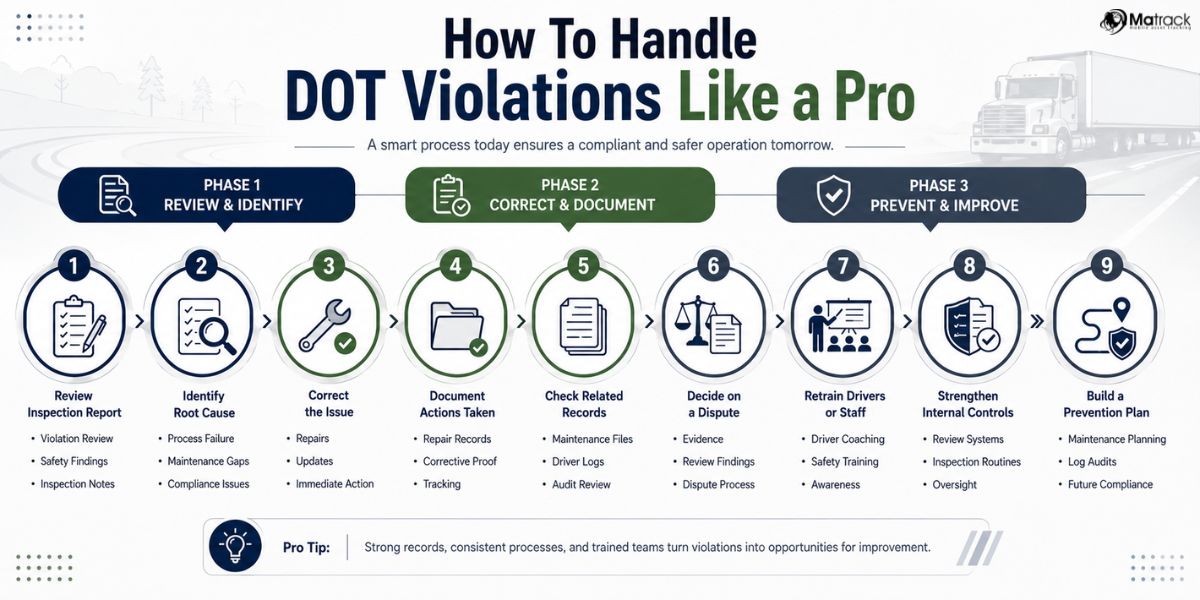
Handling DOT violations like a pro requires a structured response that moves from review to correction, then from correction to prevention.
1. Review the inspection report
Start by reading the inspection report carefully and identifying every cited issue. Accurate review helps separate minor paperwork errors from violations tied to safety, maintenance, or driver compliance.
2. Identify the root cause
Find out why the violation happened instead of only looking at the final outcome. Missed maintenance, poor log management, weak supervision, or outdated records often sit behind repeat problems.
3. Correct the issue immediately
Resolve the violation as quickly as possible through repair, record updates, or compliance action. Fast correction helps reduce operational disruption and prevents one issue from affecting future inspections.
4. Document every action taken
Keep written proof of repairs, updates, retraining, and internal follow-up linked to the violation. Proper documentation supports accountability and shows that corrective steps were completed.
5. Check related compliance records
One violation often connects to other files, reports, or maintenance history that also need review. Looking beyond the original citation helps prevent hidden gaps from turning into new violations.
6. Decide whether a dispute is needed
Some violations may involve inaccurate findings or incomplete information on the report. Strong disputes should rely on records, evidence, and factual review rather than assumption or frustration.
7. Retrain drivers or staff
Violations often expose process failures or knowledge gaps across daily operations. Targeted retraining helps correct habits, improve awareness, and reduce repeat mistakes.
8. Strengthen internal controls
Use checklists, review systems, and inspection routines to tighten oversight after a violation occurs. Operational discipline improves once compliance checks become part of regular workflow.
9. Build a prevention plan
Long-term prevention matters just as much as short-term correction. Maintenance scheduling, log audits, file reviews, and driver coaching all support lower violation risk over time.
What Are the Common Causes of DOT Violations?
Recurring violations usually originate from deeper operational weaknesses rather than one-time errors.
Inconsistent compliance routines
Daily processes without structure often lead to missed steps in inspections, logs, and documentation. Irregular routines make it difficult to maintain safety standards across drivers and vehicles.
Poor communication across teams
Gaps between drivers, dispatch, and maintenance teams can result in incomplete information and delayed action. Miscommunication often leads to unresolved issues that surface during inspections.
Reactive approach to issues
Fixing problems only after they appear increases the chances of repeated violations. Operations that rely on last-minute corrections struggle to maintain long-term compliance.
Lack of accountability systems
Unclear responsibility for inspections, repairs, or record updates can create confusion within the workflow. Without defined ownership, small compliance gaps often remain unresolved.
Outdated or manual processes
Manual tracking of logs, maintenance, and records increases the risk of human error. Lack of system support can make it harder to monitor compliance in real time.
Limited visibility into operations
Absence of real-time tracking or reporting makes it difficult to detect issues early. Without visibility, fleets often discover problems only during inspections.
Weak follow-up on previous violations
Ignoring past violations or failing to address root causes can lead to repeat issues. Proper follow-up ensures that earlier mistakes do not reappear in future inspections.
How Can You Prevent DOT Violations in the Future?
Preventing DOT violations requires systems that detect and control issues before inspections.
Regular vehicle inspections
Pre-trip and post-trip inspections help identify defects and reduce the chances of violations during roadside checks. Inspection routines keep vehicles in safe operating condition.
Preventive maintenance scheduling
Planned maintenance reduces unexpected breakdowns and keeps critical components functioning properly. Timely servicing prevents minor wear from developing into compliance issues.
Driver compliance monitoring
Tracking driver activity, logs, and behavior helps detect irregular patterns before they turn into violations. Ongoing monitoring supports better control over hours, safety practices, and rule adherence.
Structured training programs
Regular training keeps drivers and staff aligned with compliance requirements and inspection expectations. Practical guidance improves awareness and reduces avoidable mistakes.
Internal compliance audits
Routine audits help identify gaps in operations, records, and maintenance before external inspections take place. Timely review allows corrective action without added pressure.
Centralized record management
Organized storage of logs, inspection reports, and driver files ensures accuracy and quick access. Proper record control reduces errors and supports smooth compliance checks.
Use of compliance tools and systems
Digital systems provide real-time visibility into fleet activity, maintenance status, and documentation. Improved visibility helps teams respond faster and maintain compliance standards.
Final Thoughts
Handling DOT violations requires discipline, consistency, and a clear process across operations. Quick response, accurate correction, and proper documentation help reduce long-term compliance risk.
Operational stability improves once violations are treated as signals of deeper process gaps. Fixing root causes strengthens maintenance routines, driver management, and record control.
Sustained compliance depends on daily habits rather than one-time fixes or reactions. Structured systems, regular audits, and ongoing training support long-term safety and performance.
Frequently Asked Questions
How should a DOT violation be handled?
A DOT violation should be handled by reviewing the report, fixing the issue immediately, documenting the correction, and taking steps to prevent recurrence.
Can a DOT violation lead to out-of-service orders?
Yes, serious violations related to safety, such as brake defects or HOS limits, can result in a vehicle or driver being placed out of service.
Do DOT violations affect business operations?
Yes, violations can cause delays, increase costs, disrupt schedules, and reduce operational efficiency across fleet activities.
Can DOT violations be disputed?
Yes, incorrect or inaccurate violations can be challenged through an official review process with proper supporting evidence.
Who is responsible for DOT violations?
Responsibility can fall on both drivers and fleet operators depending on whether the issue involves behavior, maintenance, or compliance management.
How can repeat DOT violations be avoided?
Repeat violations can be avoided by maintaining regular inspections, improving training, strengthening recordkeeping, and using structured compliance systems.