

What Is a Dry Van Truck?
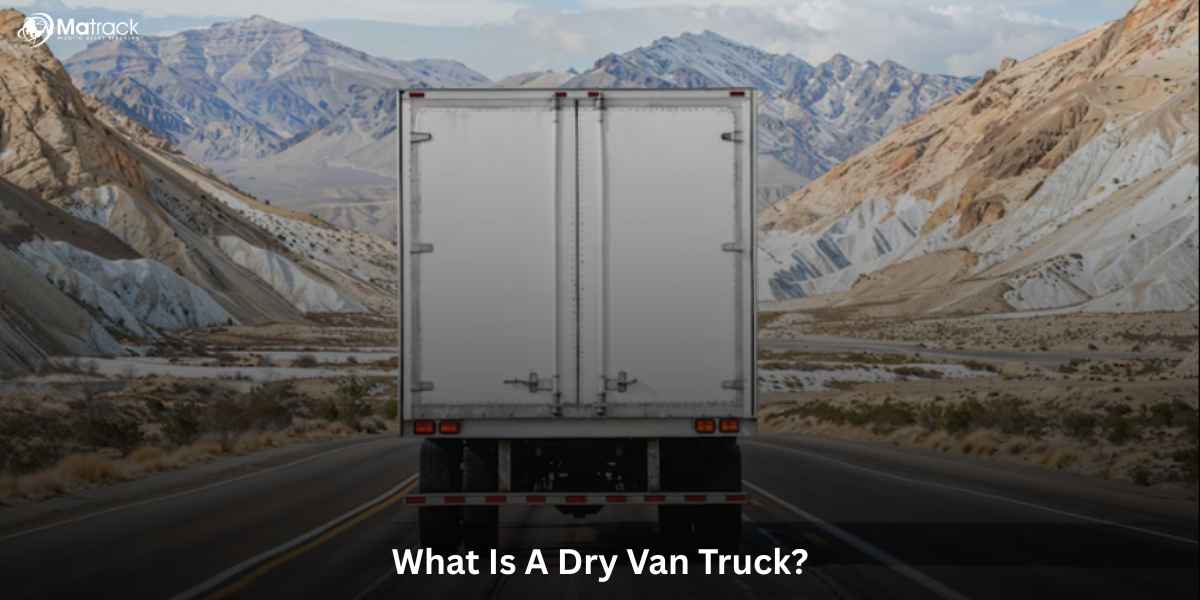
Dry van truck is a freight vehicle used in trucking, freight transportation, and logistics to move cargo inside an enclosed, non-refrigerated dry van trailer. In most cases, the term refers to a semi-truck hauling a dry van trailer for standard freight shipping.
Supply chain and transportation operations use dry van trucks to move non-perishable goods, palletized freight, and packaged cargo across regional and long-haul routes. Enclosed trailer design protects freight from weather, road debris, and external exposure while supporting common commercial shipments.
What Are the Main Types of Dry Van Trucks or Trailers?
Dry van equipment includes several configurations used across freight transportation, logistics, and supply chain operations.
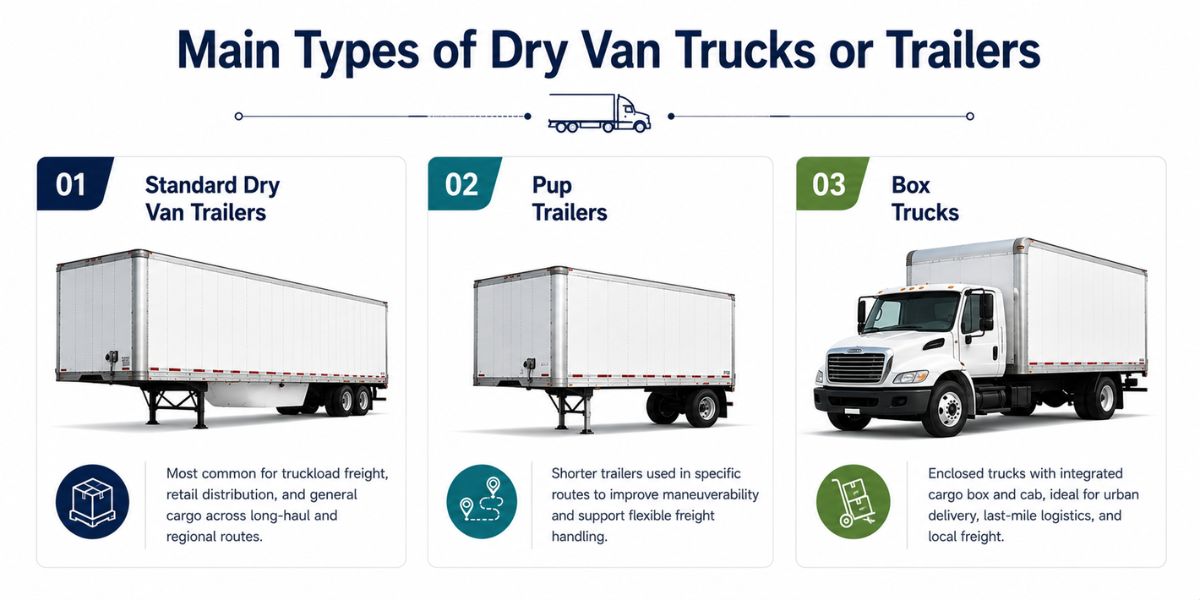
1. Standard Dry Van Trailers
Standard dry van trailers are the most common equipment type used in truckload shipping, retail distribution, and general freight movement. The enclosed design supports secure transport for non-perishable goods, palletized freight, and packaged cargo across long-haul and regional routes.
2. Pup Trailers
Pup trailers are shorter dry van trailers used in specific transport routes where smaller trailer size improves maneuverability and load planning. Regional logistics operations often use them for flexible freight handling in tighter delivery environments.
3. Box Trucks
Box trucks are enclosed freight vehicles where the cargo box and truck cab are built as one unit instead of using a separate trailer. Urban delivery, last-mile logistics, and local freight transportation often rely on box trucks for smaller shipment volumes and frequent stops.
Which Industries Use Dry Van Trucks the Most?
Dry van transportation supports both freight types and industry applications across modern logistics and supply chain systems.
1. Retail Distribution
Retail businesses depend on organized freight movement between warehouses and stores to meet customer demand. Protected trailer space keeps merchandise safer during regional and long-haul transportation.
Clothing, packaged merchandise, and store inventory move frequently through dry van trailers across distribution networks. High shipment volume makes this equipment essential for maintaining stock levels in retail operations.
2. E-Commerce Fulfillment
Online retail operations rely on continuous freight movement to support order fulfillment and inventory flow across multiple locations. Growing e-commerce demand has increased the need for dependable trailer-based shipping.
Electronics, paper goods, furniture, and boxed household items are transported in dry van trailers between fulfillment centers. Structured packaging allows efficient loading and secure handling during transportation.
3. Manufacturing
Production facilities require consistent freight delivery to maintain operational timelines and avoid supply chain disruption. Organized trailer loading helps materials arrive safely between plants, warehouses, and suppliers.
Tools, palletized supplies, and production components are shipped through dry van networks in large volumes. Truckload (FTL) and less-than-truckload (LTL) shipping support regular movement across manufacturing operations.
4. Automotive Supply
Automotive logistics depends on timely shipment of parts between suppliers, warehouses, and assembly plants. Reliable trailer-based transport supports safe handling of sensitive mechanical components.
Vehicle components and replacement parts move regularly in dry van trailers across supply networks. Protection from moisture, dust, and road exposure helps maintain product quality during transportation.
5. Consumer Goods
Consumer goods distribution requires stable transportation to maintain product flow across local, regional, and national markets. Secure trailer conditions help reduce freight damage during delivery.
Household products, personal care items, and packaged supplies are commonly shipped using dry van equipment. High-volume palletized freight makes this method efficient for large-scale distribution systems.
6. Food and Beverage
Food distribution systems rely on steady transportation to move non-perishable goods to warehouses, retailers, and commercial buyers. Standard trailer conditions work well for products that do not require refrigeration.
Shelf-stable items, dry ingredients, and sealed consumables are transported using dry van trailers. Packaging integrity remains important for safe delivery across logistics networks.
7. Wholesale Distribution
Wholesale businesses rely on continuous freight movement to keep products flowing to retailers, dealers, and commercial buyers. Covered trailer space helps preserve cargo condition during long-distance transportation.
Bulk packaged goods, inventory stock, and shipment-ready products move through dry van trailers between distribution centers and business locations. Large freight volumes make dry van transportation a practical choice for wholesale supply operations.
Dry Van vs Reefer vs Flatbed: What Is the Difference?
Trailer selection depends on cargo type, handling method, and transport requirements across logistics operations.
| Feature | Dry Van Trailer | Reefer Trailer | Flatbed Trailer |
| Trailer Type | Enclosed, non-refrigerated trailer | Enclosed trailer with refrigeration unit | Open-deck trailer with no enclosure |
| Cargo Type | Non-perishable, packaged, palletized goods | Perishable goods like food and pharmaceuticals | Oversized, heavy, or irregular cargo |
| Temperature Control | No temperature control | Maintains specific temperature range | No temperature control |
| Loading Method | Rear-door loading with forklifts or docks | Rear-door loading with controlled environment | Side, rear, or top loading using cranes or forklifts |
| Cargo Protection | Protected from weather, dust, and road debris | Protected with added temperature stability | Exposed to weather unless covered |
| Common Use Cases | Retail goods, electronics, consumer products | Fresh food, frozen items, medical supplies | Machinery, construction materials, large equipment |
| Flexibility | Best for standard freight sizes and shapes | Limited to temperature-sensitive freight | Best for large, wide, or tall loads |
| Cost Factor | Lower cost for general freight shipping | Higher cost due to cooling system | Varies based on load type and handling requirements |
What Are the Typical Dimensions of a Dry Van Trailer?
Dry van trailers usually range from 48 feet to 53 feet in length, making them suitable for standard freight transportation across regional and long-haul routes.
Trailer Length
Most dry van trailers used in commercial shipping measure 48 feet or 53 feet long. Longer trailer length allows more cargo space for palletized freight, boxed goods, and packaged shipments.
Trailer Width
Standard dry van trailers are typically 8 feet 6 inches wide on the outside. Usable interior width is slightly less, which affects how pallets and freight units are arranged during loading.
Trailer Height
Exterior trailer height generally reaches about 13 feet 6 inches, which aligns with common highway clearance limits. Interior height often ranges from 8 feet to 9 feet, depending on trailer design and manufacturer specifications.
Freight Capacity
Most 53-foot dry van trailers can hold around 26 standard pallets when loaded in a single layer. Cargo volume usually falls near 3,400 to 3,500 cubic feet, depending on interior configuration.
Weight Capacity
Maximum freight weight in a dry van trailer often ranges from 42,000 to 45,000 pounds based on trailer construction and legal road limits. Actual load capacity can vary depending on axle setup, equipment weight, and shipment distribution.
Why Are Dry Van Trucks Important in Logistics?
Reliable freight movement keeps products flowing across warehouses, distribution centers, and commercial supply chains.
Supply Chain Connectivity
Dry van trucks move packaged and non-perishable goods between suppliers, warehouses, distribution centers, and retail locations. Continuous transportation across these points helps maintain steady inventory flow in logistics operations.
High-Volume Shipping
Large shipment volumes across retail, manufacturing, and wholesale sectors require equipment built for repeated freight movement. Dry van trailers support this demand by carrying palletized and boxed cargo across regional and long-haul routes.
Infrastructure Compatibility
Warehouse docks, loading bays, and freight terminals are commonly built around standard dry van trailer dimensions. Direct compatibility with existing logistics infrastructure supports smoother loading and unloading processes.
Transportation Cost Control
Standard trailer use helps businesses avoid the added expense that comes with refrigerated or specialized freight equipment. General cargo shipping becomes easier to manage when transportation costs remain more predictable.
Route Flexibility
Dry van trucks operate across local, regional, and long-distance freight routes without major equipment changes. Broad route compatibility allows carriers and shippers to use the same trailer type in multiple logistics scenarios.
How Do You Choose the Right Dry Van Truck for Your Needs?
Choosing the right dry van truck depends on cargo requirements, route conditions, and day-to-day transportation needs.
Freight Type
Cargo should match the purpose of a dry van trailer, which is built for non-perishable and packaged freight. Products that need refrigeration, open-deck loading, or liquid transport require different equipment.
Trailer Length
Common dry van trailer lengths such as 48 feet and 53 feet support different shipment volumes and loading plans. Higher freight volume usually requires larger trailer space for palletized and boxed cargo.
Cargo Capacity
Weight and volume both matter when selecting a trailer for regular freight movement. Load planning should consider pallet count, cubic capacity, and legal weight limits before shipment begins.
Route Type
Regional deliveries, long-haul freight, and urban transportation all create different equipment needs. Route distance and road conditions help determine whether a full-size trailer or smaller enclosed vehicle is more suitable.
Loading Access
Warehouse setup and dock compatibility affect how easily freight can be loaded into a dry van truck. Rear-door access works well for standard docks, forklifts, and organized pallet loading.
Tracking Features
Real-time visibility helps businesses manage deliveries, route progress, and shipment coordination across logistics operations. Fleet tracking systems support better control over vehicle location, driver movement, and freight status.
How Can Matrack GPS Fleet Tracking Improve Dry Van Operations?
Matrack GPS fleet tracking improves dry van operations by providing real-time visibility into vehicle movement and freight status across logistics networks. Live location tracking and instant alerts help businesses respond quickly to delays, route changes, and unexpected events.
Route planning and dispatching become more controlled with Matrack’s integrated system, allowing accurate job assignment and optimized delivery paths. Data-driven routing reduces unnecessary mileage, supports better scheduling, and helps maintain consistent delivery timelines.
Operational control increases through centralized dashboards that combine GPS tracking, driver activity, and compliance data in one platform. Features like ELD integration, fuel insights, and custom alerts help improve coordination, reduce costs, and manage dry van fleets more effectively.