

What Is a Safe Following Distance for Trucks?
Safe following distance for trucks is the time gap a driver maintains behind another vehicle to ensure enough space to react and stop safely. This gap is measured in seconds so it naturally adjusts based on speed and road conditions.
The Federal Motor Carrier Safety Administration (FMCSA) recommends keeping one second of distance per 10 feet of vehicle length when traveling below 40 mph. Once speed increases beyond 40 mph, an extra second should be added to account for longer stopping time.
For example, a 40-foot truck needs about a 4-second gap at lower speeds and around 5 seconds at higher speeds. In rain, fog, or similar conditions, doubling that gap helps maintain control and reduce collision risk.
Why Do Trucks Require a Longer Following Distance Than Cars?
Trucks require a longer following distance than cars due to their greater weight and momentum, which increases the time needed to slow down. A fully loaded truck can weigh up to 80,000 pounds, making sudden stops much more difficult.
Air brake systems add a slight delay compared to the braking systems used in passenger vehicles. That delay increases total stopping time, especially at higher speeds.
Longer vehicle length also contributes to increased stopping requirements, as more space is needed to stabilize and halt safely. Combined factors make maintaining a larger gap essential to prevent rear-end collisions.
How Is Following Distance for Trucks Calculated?
Following distance for trucks is calculated through real-time judgment, using consistent time tracking and spacing awareness on the road.
- 1 Sec per 10 Ft Rule (Application): Vehicle length is mentally translated into seconds while driving. A 50-foot truck aligns with about a 5-second gap, while longer vehicles require proportionally more spacing.
- 7-Second Guideline (Highway Use): Highway conditions typically require maintaining a steady 6–8 second gap. This serves as a practical benchmark when exact vehicle length estimation is not being used.
- Speed-Based Adjustment: Higher speeds reduce reaction margin and increase stopping range. Wider gaps become necessary as speed rises, even without changes in vehicle size.
- Real-Time Measurement: Roadside objects such as signs or poles act as reference points for counting seconds between vehicles. Shorter counts signal unsafe spacing and require immediate correction.
- Adverse Conditions Response: Rain, fog, snow, or downhill driving reduces traction and visibility. Larger gaps help maintain control and minimize the risk of sudden braking or collisions.
What Is the Total Stopping Distance of a Truck?
Total stopping distance is the complete space a truck covers from the moment a hazard is noticed to a full stop. Reaction time and braking performance together determine how much distance is needed to avoid impact.
Higher speeds and heavier loads significantly increase stopping requirements, making proper spacing essential. Fully loaded trucks at highway speeds can require hundreds of feet to come to a complete stop.
Driving conditions, surface grip, and braking efficiency all influence how quickly a truck can slow down. Longer vehicles carrying heavy loads require additional space, reinforcing the need for maintaining a safe following gap.
Following Distance Chart for Trucks by Speed
Following distance depends on truck length, speed, and driving conditions, so the chart below combines the base rule, added highway time, and adverse-condition adjustment in one place.
| Truck Length | Base Gap Below 40 mph | Gap Above 40 mph | Typical Use Example | Adverse Conditions Gap | Why It Changes |
|---|---|---|---|---|---|
| 40 feet | 4 seconds | 5 seconds | Box truck or smaller commercial unit | 8–10 seconds | Higher speed increases stopping time, and rain or fog reduces control |
| 50 feet | 5 seconds | 6 seconds | Medium commercial truck or trailer combo | 10–12 seconds | Longer vehicle length requires more reaction and braking space |
| 60 feet | 6 seconds | 7 seconds | Large delivery truck or semi combination | 12–14 seconds | Added length and load increase total stopping distance |
| 70 feet | 7 seconds | 8 seconds | Standard tractor-trailer setup | 14–16 seconds | Highway travel and trailer length demand maximum spacing |
| 80 feet | 8 seconds | 9 seconds | Longer commercial combinations where permitted | 16–18 seconds | Extra vehicle length and weight require the largest safety buffer |
What Factors Affect Safe Following Distance for Trucks?
Several driving variables influence how safe following distance changes in real-world situations, requiring constant awareness and adjustment.
Vehicle Speed
Higher speeds reduce the time available to react and increase the distance needed to slow down. Extra spacing becomes necessary as speed rises to maintain control and avoid sudden braking.
Truck Load and Weight
Heavier cargo increases momentum and places more demand on braking systems. Fully loaded vehicles need additional space compared to lightly loaded or empty trucks.
Weather and Surface Conditions
Slippery surfaces and reduced grip make it harder for tires to maintain control during braking. Limited traction increases the space required to slow down safely.
Driver Reaction Time and Fatigue
Delayed responses reduce the ability to react to sudden changes in traffic. Mental fatigue or distraction makes maintaining a wider gap critical for safety.
Traffic Flow and Visibility
Congested roads and limited visibility reduce forward awareness of road conditions. Reduced sight distance requires maintaining extra space to respond safely.
Road Gradient and Terrain
Declines increase forward momentum and place more pressure on braking systems. Uneven terrain and elevation changes require careful spacing adjustments to stay in control.
What Are the Risks of Not Maintaining Proper Following Distance?
Failing to maintain a safe following distance reduces reaction time and increases the likelihood of collisions in changing traffic conditions.
Rear-End Collisions
Close spacing increases the chance of hitting the vehicle ahead during sudden stops. Heavy trucks generate more impact force, which can lead to serious damage and injury.
Increased Crash Severity
Higher momentum results in stronger impact when spacing is insufficient. Limited stopping space makes it difficult to reduce speed before contact.
Chain-Reaction Accidents
Insufficient spacing can trigger multiple vehicle collisions in dense traffic. One impact often leads to a sequence of crashes involving several vehicles.
Legal and Financial Consequences
Failure to maintain proper distance can lead to fines, liability claims, and increased insurance costs. Fleet operations may also face downtime and reputational damage.
Driver Stress and Fatigue
Driving too close to other vehicles increases mental pressure and reduces confidence. Continuous stress affects decision-making and overall driving performance.
What Is Tailgating in Truck Driving?
Tailgating in truck driving is the practice of following another vehicle without maintaining a safe following distance. Insufficient spacing limits the time available to react when traffic slows down or stops unexpectedly.
Heavy trucks require significant distance to slow down due to their weight and momentum, making tight gaps especially dangerous. High-impact force during a crash can lead to severe damage, injuries, and multi-vehicle incidents.
Unstable traffic movement, restricted forward visibility, and reduced maneuvering space further increase risk in such situations. Aggressive driving habits and lack of spacing control often make it harder to avoid hazards or respond safely.
What Are the Best Safety Tips for Maintaining Proper Following Distance?
Maintaining a safe following distance depends on consistent awareness, controlled driving habits, and timely adjustments based on changing conditions.
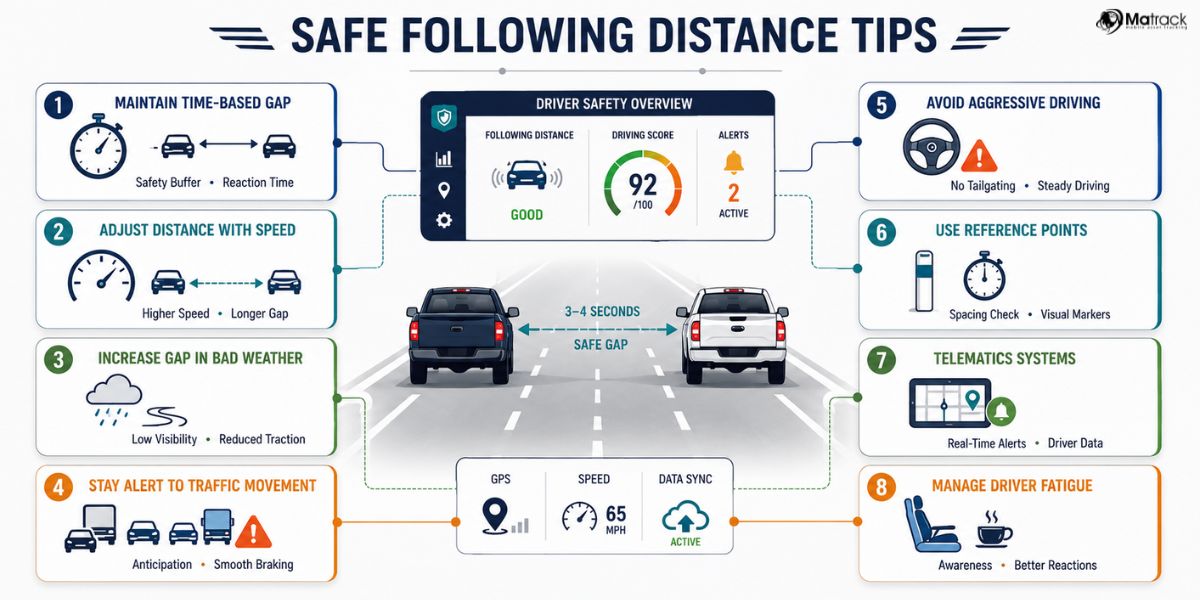
Maintain Time-Based Gap
Time-based spacing based on vehicle length and speed helps create a reliable safety buffer. Consistency in maintaining that gap reduces sudden braking situations.
Adjust Distance with Speed
Higher speeds require additional spacing to allow proper reaction and stopping time. Expanding the gap early helps avoid last-second corrections.
Increase Gap in Adverse Conditions
Low visibility, reduced traction, or uneven terrain requires extra spacing beyond normal driving. Additional distance helps maintain control and prevent sudden loss of stability.
Stay Alert to Traffic Movement
Continuous scanning of vehicles ahead improves anticipation of sudden stops or lane changes. Early awareness allows smoother adjustments without abrupt braking.
Avoid aggressive driving
Sudden acceleration, tailgating, or frequent lane changes disrupt spacing control. Calm and steady driving helps maintain consistent distance.
Use reference points while driving
Roadside objects such as signs or poles can be used to measure spacing in seconds. Regular counting helps ensure the gap remains within a safe range.
Telematics Systems
Telematics systems track vehicle spacing, speed, and driver behavior in real time. Alerts and reports help identify unsafe following patterns and improve driving habits.
Manage Driver Fatigue
Fatigue reduces reaction speed and awareness of surroundings. Staying well-rested improves decision-making and spacing control.
How Matrack’s AI-Powered Fleet Dash Cam Can Help in Ensuring Safe Driving?
Matrack’s AI-powered fleet dash cam helps ensure safe driving by monitoring driver behavior, vehicle surroundings, and following distance in real time. Built-in ADAS and driver monitoring systems detect risks such as tailgating, distraction, and potential collisions, sending instant in-cab alerts to prompt corrective action.
Real-time GPS tracking combined with live video gives fleet managers complete visibility into vehicle movement and on-road events. Features like route playback, geo-fencing, and behavior monitoring help identify unsafe patterns and improve driver performance over time.
AI-powered event recording and cloud storage provide clear video evidence for incident review and safety analysis. Continuous alerts, multi-camera visibility, and real-time insights help prevent accidents, improve compliance, and maintain safer fleet operations.