


What Is the Meaning of a CSA Score?
A CSA score means a safety performance measurement used by the Federal Motor Carrier Safety Administration (FMCSA) to evaluate motor carriers under federal safety regulations. The Compliance, Safety, and Accountability program builds this score using data from roadside inspections, traffic violations, and reportable crashes.
Safety Measurement System (SMS) processes this data and assigns percentile rankings based on comparison with similar carriers. Lower percentiles reflect fewer safety issues, whereas higher percentiles indicate greater compliance risk and possible enforcement attention.
Violation frequency, severity, and recent activity influence a carrier’s position within these rankings. Fleet size and operational exposure are also considered in order to maintain a fair comparison across different trucking operations.
How Does the FMCSA Calculate CSA Scores?
FMCSA calculates CSA scores by applying weighted values to safety violations and converting them into percentile rankings through the Safety Measurement System (SMS).
- Data Entry: Roadside inspections and crash reports provide the raw input used in scoring. Details such as violation type, date, and inspection outcome are recorded for further evaluation.
- Severity Weighting: Numerical values are assigned based on how serious a violation is. Higher-risk issues contribute more impact compared to minor compliance gaps.
- Time Weighting: Recent records carry more influence than older ones within a 24-month window. Current driving behavior therefore plays a bigger role in shaping the score.
- BASIC Scoring: Safety data is organized into BASIC categories to track specific risk areas. Combined weighted values form a performance measure for each category.
- Normalization: Inspection volume and operational exposure are used to balance the results. Activity level and usage intensity are considered to maintain fair comparison across similar profiles.
- Percentile Ranking: Final values are compared across similar safety profiles and expressed as percentiles. Smaller values reflect fewer safety concerns, whereas higher ones indicate increased compliance risk.
What Are the Seven CSA BASIC Categories?
Seven CSA BASIC categories group safety data into focused areas that highlight different types of compliance risk tracked under FMCSA monitoring.
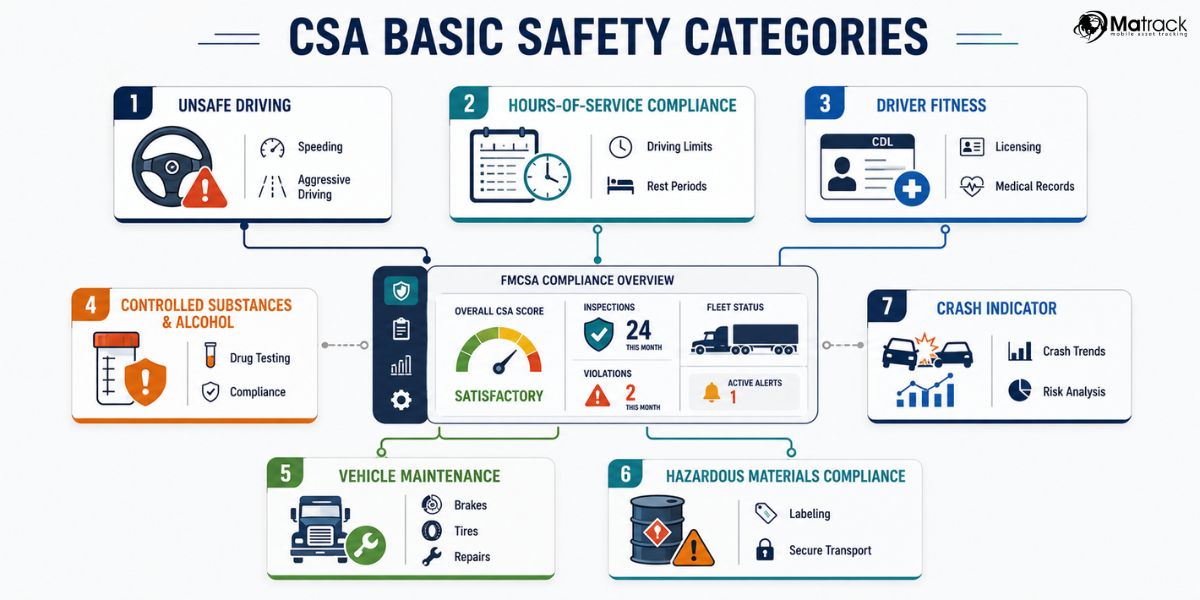
1. Unsafe Driving
Unsafe driving covers behaviors observed during enforcement checks such as speeding, aggressive lane movement, and failure to follow traffic rules. Repeated patterns in these actions signal higher road risk and directly influence safety evaluation.
2. Hours-of-Service Compliance
Driving time limits and required rest periods fall under this category to control fatigue-related risk. Inaccurate logs or extended driving hours can raise concerns around driver alertness and regulatory adherence.
3. Driver Fitness
Driver fitness focuses on qualification records including valid licensing and medical certification status. Missing or outdated documents can indicate gaps in driver eligibility and regulatory compliance.
4. Controlled Substances and Alcohol
Substance use rules are monitored through testing programs and enforcement records within this category. Failed tests or missing documentation can lead to serious safety concerns and regulatory action.
5. Vehicle Maintenance
Mechanical condition is assessed through inspection findings related to brakes, tires, lighting, and other equipment components. Frequent defects suggest weak maintenance practices and increase the chance of roadside violations.
6. Hazardous Materials Compliance
Handling of regulated materials requires strict attention to labeling, packaging, and secure transport requirements. Errors in these areas can increase risk exposure and attract higher scrutiny during inspections.
7. Crash Indicator
Crash records are analyzed to identify patterns linked to incident frequency and severity over time. Consistent involvement in crashes can signal deeper safety issues within overall fleet performance.
How to Check a CSA Score?
CSA score can be checked through FMCSA systems by accessing safety records linked to a USDOT number inside the Safety Measurement System (SMS).
Step 1: Collect Identification Details
Begin with gathering the USDOT number, which acts as the primary identifier for any motor carrier registered with FMCSA. Access credentials such as a PIN are also required to enter the SMS portal and view detailed safety data.
Step 2: Access the FMCSA SMS Platform
Open the official FMCSA Safety Measurement System (SMS) website to begin the process. Login requires entering the USDOT number along with the assigned PIN, which can be requested directly from the FMCSA portal if missing.
Step 3: Navigate to Safety Records
After login, locate the section displaying company safety profile or SMS results. Safety data appears organized under BASIC categories, showing performance across different compliance areas.
Step 4: Review Safety Performance Data
Examine scores within each BASIC category to identify areas showing higher compliance risk. Inspection reports and violation records provide detailed insight into patterns affecting overall safety performance.
Step 5: Export or Use the Report
Download the CSA report from the SMS portal for further analysis or internal review. Saved data can support corrective actions such as driver training, maintenance planning, or compliance improvements.
How Drivers Can Check Their Safety Records
FMCSA assigns safety performance at the motor carrier level, while individual driving history can still be reviewed through the Pre-Employment Screening Program (PSP), where CSA-related data appears as inspection and violation records.
- Visit the PSP Website: Open the official FMCSA PSP portal to begin the process. The platform displays driver-related details such as roadside inspection results and crash history.
- Create or Sign In to Account: Register using personal identification details if no profile exists on the PSP system. Returning users can sign in with existing credentials to continue.
- Request PSP Report: Submit a request within the PSP system to generate the report. A standard fee, typically around $10, is required to retrieve the record.
- Review Inspection: The report includes entries from roadside inspections, recorded violations, and crash-related information linked to the driver. These records reflect the same data used in CSA score calculations at the carrier level.
- Use the report for compliance tracking: Information from the report helps identify recurring safety concerns and supports corrective actions. Regular review contributes to improved driving practices and better compliance outcomes.
What Are the Key Benefits of a Good CSA Score?
A good CSA score supports safer operations and improves how a motor carrier is evaluated under FMCSA safety monitoring systems.
Lower Insurance Costs
Insurance providers review CSA data, inspection history, and violation records before setting premiums. Cleaner safety records often lead to more favorable policy terms and reduced financial risk.
Reduced FMCSA Actions
Strong safety performance lowers the chances of audits, warning letters, and investigations from FMCSA. Fewer interventions allow smoother operations without regulatory pressure.
Higher Business Trust
Shippers and brokers review safety profiles before assigning loads. Consistent compliance builds credibility and increases business opportunities.
Fewer Inspection Issues
Stable safety records reduce the likelihood of violations during roadside inspections. This helps avoid delays, penalties, and out-of-service situations.
Improved Driver Behavior
Safety data highlights patterns linked to violations and compliance gaps. Managers can use this insight to guide training and improve driving practices.
Stable Operations
Compliance reduces disruptions caused by violations or enforcement actions. Predictable performance supports better planning and overall efficiency.
What Is Considered a Good CSA Score?
Performance is measured using percentile rankings, with lower values indicating better safety compliance and higher values reflecting increased regulatory risk.
| Category | Score Threshold | Consequence |
| Unsafe Driving, Crash Indicator, HOS Compliance | Greater than 65 percentile | Subject to intervention and monitoring actions |
| Hazardous Materials Compliance | Greater than 50 percentile | May face investigation and compliance review |
| Driver Fitness, Vehicle Maintenance, Controlled Substances | Greater than 80 percentile | High-risk classification with enforcement actions |
| All BASIC Categories | Less than 50 percentile | Considered good performance with lower compliance risk |
How Can You Improve CSA Scores?
Improving CSA scores depends on reducing violations and strengthening safety practices across driving, vehicle condition, and compliance tracking.
Driver Training
Training programs help drivers correct risky habits such as speeding, harsh braking, and log errors. Focused coaching improves awareness and reduces repeated violations over time.
Vehicle Maintenance
Consistent servicing of brakes, tires, and lighting systems helps prevent mechanical defects. Well-maintained equipment lowers the chances of failing safety checks.
ELD Usage
Electronic Logging Devices ensure accurate tracking of hours-of-service (HOS) records. Proper usage reduces logbook errors and improves compliance with driving limits.
Telematics Systems
Tracking tools monitor driving patterns such as acceleration, braking, and idle time. Insights from this data help identify unsafe behavior and guide corrective actions.
Violation Monitoring
Inspection reports and safety records should be reviewed to detect recurring issues. Early action prevents small problems from turning into repeated violations.
Data Correction
Incorrect records can be challenged through the DataQs system. Fixing errors ensures that safety data reflects actual performance.
Final Thoughts
CSA scores play a central role in evaluating safety performance across trucking operations, connecting inspection records, violation history, and crash data into one measurable system. A well-managed score reflects disciplined driving, proper vehicle upkeep, and consistent compliance with safety standards.
Long-term improvement depends on continuous monitoring of safety data and timely correction of risk patterns. Training, maintenance, and data accuracy work together to reduce violations and support stable performance over time.
Effective use of tracking systems and safety tools helps turn raw data into actionable insights. Consistent focus on compliance and performance not only improves CSA outcomes but also strengthens overall operational reliability.
Frequently Asked Questions
Can individual drivers have a CSA score?
No, CSA scores are assigned only to motor carriers under FMCSA regulations. Driver violations are still recorded and can impact the carrier’s overall safety rating.
Do CSA scores matter?
Yes, CSA scores are important for evaluating safety performance and compliance levels. They influence insurance costs, business reputation, and load opportunities.
How often are CSA scores updated?
CSA scores are updated on a monthly basis through the Safety Measurement System (SMS). New inspection data and violations are included in each update cycle.
What is a good CSA score?
A good CSA score means maintaining a low percentile ranking across BASIC categories. Lower percentiles indicate better safety performance and fewer compliance issues.
How can incorrect CSA data be fixed?
Incorrect CSA data can be challenged through the DataQs system provided by FMCSA. Supporting documents must be submitted to request a review and correction.