

What Does Freight Factoring Mean?
Freight factoring means a carrier sells an unpaid freight invoice from a completed load to a factoring company and receives cash before the broker or shipper makes payment. Invoice value moves from accounts receivable into working capital without creating loan-based debt.
Instead of waiting 30, 60, or 90 days for customer payments, trucking companies can receive a large portion of the invoice amount upfront, often within 24 to 48 hours. Owner-operators and fleet operators use freight factoring to keep fuel, payroll, insurance, and maintenance expenses running without interruption.
Faster access to invoice value gives carriers steadier control over cash flow after delivery. Invoice ownership, customer payment timelines, and advance payment terms shape how freight factoring works in real trucking operations.
How Does Freight Factoring Work?
Freight factoring works through an invoice-to-cash process where a completed load becomes eligible for funding after document review and customer credit approval.
- Load Completion: Finished delivery creates a receivable supported by proof of delivery, bill of lading, and rate confirmation.
- Invoice Submission: Trucking companies send the unpaid freight invoice and load paperwork for funding review.
- Verification Review: Factoring teams check delivery proof, invoice amount, broker or shipper credit, payment terms, and duplicate billing risk.
- Advance Release: Approved invoices receive funding based on the agreed advance rate, often within 24 to 48 hours.
- Customer Collection: Broker, shipper, or customer payment goes directly to the factoring company under original invoice terms.
- Reserve Settlement: Remaining balance reaches the carrier after deduction of the factoring fee or discount fee.
Who Uses Freight Factoring in the Trucking Industry?
Trucking businesses use freight factoring when completed deliveries create invoices, but operating costs need faster funding.
- Owner-Operators: Independent drivers use invoice advances to cover fuel, insurance, repairs, and personal income between customer payments.
- Small Fleets: Small trucking companies use factoring support to manage payroll, maintenance, dispatch costs, and recurring operating expenses.
- New Authorities: New trucking businesses often qualify through invoice quality, broker credit, and shipper payment reliability instead of long operating history.
- Growing Carriers: Expanding carriers use faster invoice funding to accept more loads without straining working capital.
- Fleet Operators: Multi-truck operators use factoring to stabilize cash flow across several invoices, customers, routes, and payment timelines.
What Are the Main Types of Freight Factoring?
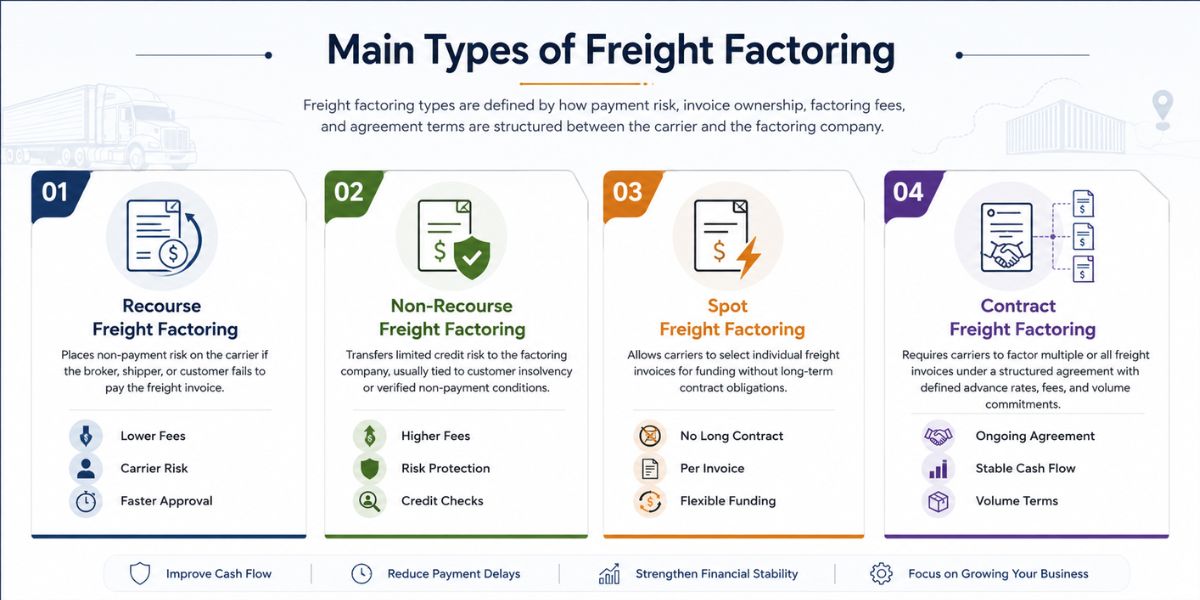
Freight factoring types are defined by how payment risk, invoice ownership, factoring fees, and agreement terms are structured between the carrier and the factoring company.
1. Recourse Freight Factoring
Recourse freight factoring places non-payment risk on the carrier if the broker, shipper, or customer fails to pay the freight invoice. Lower factoring fees apply because the factoring company advances funds without taking full credit risk on accounts receivable.
2. Non-Recourse Freight Factoring
Non-recourse freight factoring transfers limited credit risk to the factoring company, usually tied to customer insolvency or verified non-payment conditions. Higher factoring fees apply due to added risk coverage, stricter invoice approval, and deeper customer credit checks.
3. Spot Freight Factoring
Spot freight factoring allows carriers to select individual freight invoices for funding without long-term contract obligations. Flexibility increases, but factoring fees per invoice may be higher due to irregular volume and selective submission.
4. Contract Freight Factoring
Contract freight factoring requires carriers to factor multiple or all freight invoices under a structured agreement with defined advance rates, fees, and volume commitments. Consistent funding and predictable cash flow improve, but contract terms, cancellation clauses, and minimums must be evaluated carefully.
How Much Does Freight Factoring Cost?
Costs usually range from 2% to 5% per invoice, with upfront advances commonly around 80% to 95% of the freight invoice value.
Factoring Fee
A factoring fee is the percentage charged by the factoring company on the freight invoice value. Typical fees often range around 2% to 5% per invoice, depending on risk, customer reliability, and payment duration.
Advance Rate
Advance rate refers to the portion of the freight invoice paid upfront to the carrier. Many factoring companies advance around 80% to 95% of the invoice value, while the remaining balance stays as a reserve until customer payment.
Customer Credit Risk
Broker or shipper credit strength affects factoring cost because customer payment reliability controls invoice risk. Low-risk customers may support better pricing, while high-risk accounts can increase fees or reduce approval chances.
Invoice Volume
Higher invoice volume can help trucking companies negotiate better factoring terms. Consistent freight invoices reduce uncertainty for the factoring company and may lower per-invoice costs.
Payment Terms
Longer customer payment timelines can increase factoring costs because the factoring company waits longer to collect. Shorter payment cycles usually reduce risk and may support lower fees.
Factoring Type
Non-recourse factoring usually costs more because the factoring company accepts limited credit risk. Recourse factoring usually costs less because unpaid invoice responsibility stays with the carrier.
Additional Charges
Additional costs may include administrative fees, wire fees, ACH fees, monthly minimums, contract fees, or early termination charges. Full agreement review matters because advertised rates may not show the complete cost.
Know More About: What is the Cost of Factoring?
What Are the Benefits of Freight Factoring?
Quick invoice funding helps trucking companies protect cash flow, cover operating expenses, and keep freight operations moving between customer payment cycles.
- Faster Payments: Funds arrive soon after load delivery, helping cover expenses without waiting on broker or shipper settlements.
- Steady Cash Flow: Predictable working capital supports fuel purchases, payroll, insurance, repairs, maintenance, and dispatch operations.
- Reduced Collections: Factoring companies manage payment follow-ups, reducing administrative pressure on carriers and back-office teams.
- Credit Checks: Broker and shipper credit reviews help trucking companies avoid risky customers before accepting loads.
- Growth Support: Load capacity can increase because working capital stays available instead of being tied up in unpaid receivables.
- No Loan Debt: Receivable-based funding avoids traditional bank loan debt, collateral requirements, and long approval processes.
- Fuel Coverage: Immediate access to funds helps manage fuel costs between deliveries, especially during high-volume operations.
- Back-Office Relief: Billing, payment tracking, and accounts receivable management become easier for small trucking teams.
What Are the Risks or Drawbacks of Freight Factoring?
Cost, risk transfer, and contract control can make freight factoring less suitable for carriers with tight margins or inconsistent customer payment quality.
- Reduced Profit: Factoring fees lower the final amount earned from a completed load, especially when freight rates are already narrow.
- Recourse Liability: Under recourse agreements, unpaid customer balances can return to the carrier if a broker or shipper fails to pay.
- Contract Limits: Minimum volume rules, cancellation clauses, and termination fees can reduce flexibility for owner-operators and small fleets.
- Customer Handling: Collection activity by the factoring company may affect broker or shipper relationships if communication is poor.
- Extra Charges: Wire fees, ACH fees, service costs, and account minimums can raise the total expense beyond the advertised rate.
- Credit-Based Approval: Weak customer credit can delay funding, lower advance rates, or prevent approval for certain freight invoices.
How Is Freight Factoring Different from Quick Pay and Bank Loans?
Payment speed, cost structure, approval criteria, and financial impact create clear differences between freight factoring, quick pay, and traditional bank loans.
| Comparison Point | Freight Factoring | Quick Pay | Bank Loans | Waiting for Payment |
| Funding Source | Factoring company purchases freight receivables | Broker pays early for selected loads | Bank or lender provides borrowed capital | Broker, shipper, or customer pays on normal terms |
| Payment Speed | Often within 24 to 48 hours after approval | Usually faster than standard broker payment | Slower due to underwriting and approval | Depends on customer payment cycle |
| Approval Basis | Customer credit, invoice quality, delivery proof, payment terms | Broker program rules and load eligibility | Business credit, financial history, collateral, revenue | No approval needed |
| Cost Structure | Factoring fee or discount fee deducted from invoice value | Early payment fee deducted from freight payment | Interest, origination fees, repayment charges | No direct fee |
| Debt Impact | Does not create traditional loan debt | Does not create loan debt | Creates repayment obligation | No debt created |
| Risk Factor | Recourse terms may return unpaid balance responsibility to carrier | Limited to broker’s quick pay policy | Borrower must repay regardless of load activity | Cash flow delays remain with the carrier |
| Best Fit | Carriers needing steady working capital across multiple customers | Carriers hauling for brokers with reliable quick pay programs | Established companies needing larger capital | Carriers with strong reserves and predictable customer payments |
What Should Trucking Companies Look for in a Freight Factoring Company?
Choosing a factoring partner requires reviewing funding speed, total cost, contract flexibility, risk checks, and trucking-specific support.
Transparent Fees
Review the factoring fee, discount fee, reserve policy, wire fees, ACH fees, monthly minimums, and early termination charges. Total cost matters more than the advertised rate.
Competitive Advance Rate
Compare how much freight invoice value gets paid upfront and how quickly the reserve gets released. Higher advance rates can improve working capital, but fee structure still needs review.
Fast Funding
Look for same-day or 24–48 hour funding after approval. Fast payment matters when fuel, payroll, repairs, and maintenance costs depend on steady cash flow.
Flexible Contract Terms
Avoid strict volume minimums, long lock-ins, unclear cancellation clauses, or heavy termination penalties. Flexible terms help owner-operators and small fleets stay in control.
Customer Credit Checks
Broker and shipper credit reviews help reduce non-payment risk before accepting loads. Strong credit screening also protects carriers from unreliable customer accounts.
Trucking Experience
Factoring providers should understand bills of lading, rate confirmations, proof of delivery, and freight broker payment cycles. Industry experience usually makes invoice review and funding smoother.
Final Thoughts
Freight factoring helps trucking companies turn unpaid receivables into working capital for fuel, payroll, repairs, insurance, and daily operations. Faster access to freight payments supports cash flow without creating traditional loan debt.
Cost, advance rate, recourse terms, customer credit, and contract flexibility should guide every factoring decision. Hidden charges, strict minimums, or poor collection practices can make a low advertised fee more expensive.
Owner-operators, small fleets, and growing trucking businesses benefit most when factoring supports cash flow without reducing operational control. Reliable factoring partners make payment cycles easier to manage without adding financial pressure.
Frequently Asked Questions
What should I look for in a freight factoring company?
Key factors include reputation, experience in the trucking industry, transparent fees, flexible contract terms, competitive advance rates, and excellent customer service. Know More.
Do I have to factor all my invoices?
Not always. Some companies offer flexibility, allowing you to choose which invoices to factor, while others may require factoring all invoices.
Are there hidden fees in freight factoring?
Some companies charge additional fees like monthly minimums, small invoice fees, or contract termination penalties. Review contracts carefully for transparency.
How do I know if freight factoring is right for my business?
If delayed payments disrupt your cash flow or you need immediate funds for operating expenses, factoring is likely a good fit.
Can freight factoring help small or startup trucking businesses?
Yes, it is especially beneficial for startups and small trucking businesses with limited access to traditional loans or credit.
Does freight factoring impact my credit score?
No, freight factoring does not affect your credit since it is not a loan. The factoring company evaluates your customers’ creditworthiness.
Is freight factoring a loan?
No, it is not a loan. Factoring involves selling unpaid invoices for immediate cash and does not create debt.
Do only struggling trucking businesses use factoring?
No, many profitable trucking companies use factoring as a strategic tool to stabilize cash flow and fund growth.