

Anti-lock Braking System Explained
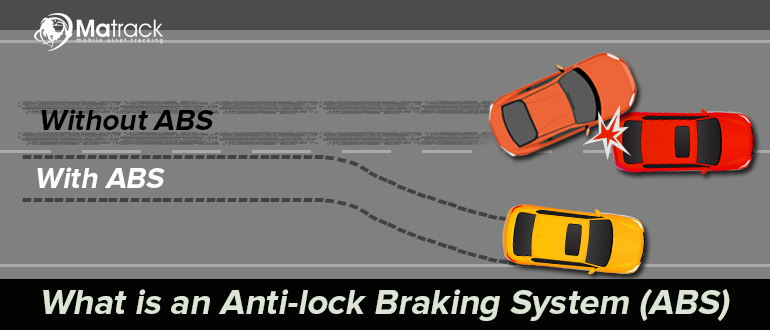
An Anti-lock Braking System (ABS) is a safety feature that helps prevent wheel lock-up during hard braking. Wheel lock-up happens when wheels stop turning while a vehicle is still moving, which can cause tires to skid and reduce steering control. By keeping wheels rotating just enough, ABS lets a driver brake firmly while still being able to steer.
System works through wheel speed sensors, an electronic control unit, hydraulic valves, and a pump. Sensors track how fast each wheel is turning, and a sharp drop in speed tells the control unit that one wheel may be close to locking. Hydraulic valves briefly reduce brake pressure, then a pump restores it once rotation returns.
ABS repeats this pressure release-and-restore cycle many times per second, which is why a brake pedal may feel like it is pulsing. During emergency braking, ABS helps drivers stay in control, especially on wet, icy, or uneven roads. Its main purpose is control, not always a shorter stopping distance, so good tires, safe speed, and enough space from a vehicle ahead are still needed.
Why Do Wheels Lock During Hard Braking?
Wheels lock during hard braking when braking force becomes stronger than a tire’s grip on the road. Instead of rolling, a wheel stops turning while the vehicle keeps moving forward. This causes the tire to slide across the surface, which is called skidding.
Road conditions can make wheel lock-up more likely. Wet pavement, ice, loose gravel, worn tires, and sudden panic braking all reduce traction. Once grip drops, even strong brakes cannot keep tires properly connected to the road.
Locked wheels are dangerous because they reduce steering control. Rolling tire can still guide a vehicle, but a skidding tire mostly follows the vehicle’s momentum. That is why ABS tries to keep wheels rotating during hard braking instead of letting them lock completely.
How Does an Anti-lock Braking System Work?
ABS works by monitoring wheel speed and quickly adjusting brake pressure so the wheels keep rotating during hard braking.
Wheel Speed Sensors
Wheel speed sensors provide rotation data so ABS can track how fast each wheel is moving. If one wheel slows much faster than others, ABS reads that sudden change as a possible lock-up.
Accurate sensor input is critical because ABS depends on real-time wheel-speed comparison. Without reliable data, ABS cannot identify which wheel needs brake pressure adjustment.
ABS Control Unit
Inside an ABS control unit, wheel speed signals are processed to decide whether braking intervention is needed. Rapid wheel deceleration tells the control unit that tire grip may be dropping.
Once lock-up risk is detected, commands go to hydraulic valves. Brake pressure is then adjusted at the affected wheel instead of reducing braking force across the whole system.
Hydraulic Valves
Hydraulic valves control brake pressure at each wheel during ABS operation. Based on available traction, valves can reduce pressure, hold it steady, or allow pressure to build again.
Pressure release helps a locked or near-locked wheel start rotating again. Holding or restoring pressure keeps braking force available without letting the tire slide.
ABS Pump
After hydraulic valves release pressure, an ABS pump restores braking pressure so cycling can continue. Without pressure recovery, braking force would weaken after each release.
Repeated pressure recovery allows ABS to keep braking while preventing full wheel lock-up. Pedal pulsing often happens because brake pressure is being reduced and restored many times per second.
What Happens When ABS Activates?
During ABS activation, drivers may feel pedal movement, hear mechanical noise, and notice that steering remains more responsive than it would with locked wheels.
- Pedal pulsing: Rapid pedal vibration usually means ABS is releasing and restoring brake pressure several times per second. Drivers should keep firm, steady pressure on the brake pedal instead of pumping or letting up.
- Body vibration: Shuddering through the pedal, floor, or vehicle body can occur as the hydraulic unit cycles. A completely smooth brake feel is not expected while ABS is working.
- Mechanical noise: Clicking, buzzing, humming, or a grinding-like sound may come from ABS pump and valves during a hard stop. Sounds during normal driving, or noise that appears without hard braking, should be checked separately.
- Pressure changes: Brake force may feel uneven as ABS adjusts pressure at one or more wheels. Pressure cycling keeps tires closer to rolling grip instead of letting them slide.
- Steering response: Continued tire rotation allows steering input to remain useful during a panic stop. Available space, tire condition, speed, road surface, and vehicle load still limit how much control a driver has.
- Driver response: Correct action is to press the brake pedal firmly, hold pressure, and steer toward the safest open path. ABS works automatically, so manual brake pumping can interrupt pressure control.
- Service warning signs: ABS activation during light braking, unusual pedal feel outside emergency stops, repeated warning lights, or ongoing mechanical noise may indicate a fault. These symptoms should be inspected before another hard-braking event exposes the same issue again.
How Should Drivers Use Anti-lock Brakes?
Correct ABS braking requires firm pedal pressure, a steady foot position, and steering toward the safest available path.
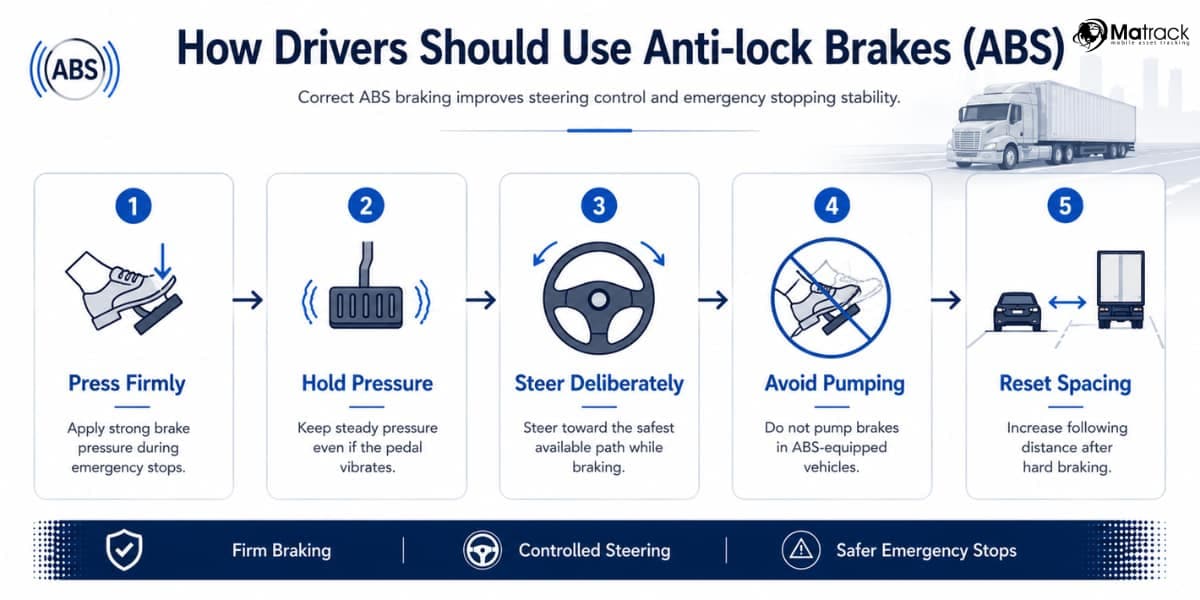
- Press firmly: Apply decisive pressure during an emergency stop. Light or hesitant braking can waste distance before ABS has enough braking force to manage.
- Hold pressure: Keep a steady foot on the brake even if it pulses, vibrates, or makes noise. Pedal feedback usually means ABS is adjusting pressure, not that brakes are failing.
- Steer deliberately: Look toward the safest open path and steer in that direction while braking. Sudden overcorrection can still cause loss of control, especially on wet, icy, or uneven roads.
- Avoid pumping: Do not pump the brake pedal in an ABS-equipped vehicle during an emergency stop. Manual pumping interrupts the pressure cycle that ABS is already managing faster than a driver can.
- Allow enough distance: ABS helps preserve steering control, but it does not cancel speed, vehicle weight, tire condition, or road surface limits. Loaded trucks, vans, and fleet vehicles still need extra following distance.
- Reset spacing after the stop: After a hard-braking incident, increase following distance and reassess speed. Traffic flow, road grip, and driver reaction time may still leave little margin for another sudden stop.
What Are the Benefits and Limits of ABS?
ABS primarily preserves steering control during hard braking, while stopping distance still depends on speed, tires, vehicle condition, and road surface.
| Comparison Point | What ABS Does | What ABS Does Not Guarantee |
| Steering control | Keeps wheels rotating enough for steering input to matter during hard braking. | Cannot create a safe escape path if speed or distance leaves no room. |
| Wheel lock-up | Reduces the chance that one or more wheels stay locked during a panic stop. | Cannot overcome worn tires, failed brakes, or very low traction. |
| Wet pavement | Modulates brake pressure when tire grip changes quickly. | Does not make wet roads behave like dry pavement. |
| Ice and packed snow | Cycles pressure when a wheel begins to lock. | May still require longer stopping distance because available grip is limited. |
| Gravel or loose snow | Preserves some steering response during braking. | May not stop shorter than a locked-wheel skid on some loose surfaces. |
| Driver behavior | Rewards firm, steady pedal pressure and controlled steering. | Cannot correct tailgating, distraction, speeding, or poor hazard scanning. |
What Does the ABS Warning Light Mean?
An ABS warning light illumination at startup is usually part of a normal dashboard bulb check. Brief lighting tells the driver that the warning indicator is working and able to alert them if the system detects a fault.
Persistent ABS warning light activity needs attention, especially if light stays on after startup or returns while driving. Standard braking may still work, but anti-lock brake pressure control may be unavailable during a skid-risk stop.
Service diagnosis usually begins with trouble codes and inspection of wheel speed sensors, wiring, brake fluid level, fuses, and hydraulic components. Brake pedal changes, unusual noise during normal driving, or an ABS light appearing with main brake warning light should move the vehicle into service review sooner.
How Does ABS Matter for Fleet Safety?
Fleet safety programs use ABS as one part of braking risk management, alongside hard-braking reports, coaching notes, dash cam clips, and maintenance tickets.
Hard-Braking Events
Sharp braking reports show where and how often drivers brake suddenly. GPS location, speed, route type, and traffic conditions help safety staff separate unavoidable hazards from repeated following-distance problems.
Driver Coaching
Coaching turns braking incidents into specific behavior changes. Driver scorecards and dash cam clips can show tailgating, late hazard recognition, distraction, or speed choices that made ABS activation more likely.
Maintenance Follow-Up
Inspection records and repair tickets connect repeated braking problems to vehicle service work. ABS warning light reports, brake complaints, tire wear, and diagnostic codes should move into a documented service path.
Final Thoughts
ABS gives drivers crucial control during sudden braking by keeping wheels from locking and helping the vehicle respond to steering. It matters most on wet, icy, uneven, or low-traction roads where a skid can quickly reduce control.
Safe braking still depends on speed, tire condition, road surface, vehicle load, and enough following distance. Drivers should press the brake firmly, hold steady pressure, and steer toward the safest open path during an emergency stop.
Fleet safety improves when ABS is supported by regular inspections, warning-light checks, driver coaching, and hard-braking reviews. Combined with good driving habits and maintenance records, ABS becomes part of a practical system for reducing braking risks.
Frequently Asked Questions
Does ABS work at all speeds?
The system works at most driving speeds, but it is most effective during moderate to high-speed braking where wheel lock-up is more likely. At very low speeds, it may not activate because skidding risk is minimal.
Can ABS fail while driving?
Failure can happen if there is an issue with sensors, wiring, or control module. In such cases, the ABS warning light turns on, and normal braking usually remains available.
Is ABS mandatory in all vehicles?
Many countries require this safety system in modern vehicles because of its braking-control benefits. Regulations vary by region, but most new cars and commercial vehicles include it as a standard feature.
Can a Vehicle Be Driven With the ABS Light On?
Standard braking may still work when ABS light is on, but anti-lock braking may be disabled. Persistent warning lights need diagnosis because ABS may not be available during a skid-risk stop.
Does ABS affect tire wear?
Under normal conditions, this system does not directly increase tire wear. By preventing skidding, it can reduce uneven wear that happens when tires slide across the road.
What is the difference between ABS and traction control?
Anti-lock braking prevents wheel lock-up during braking, while traction control prevents wheel spin during acceleration. Both systems use similar sensors but operate in different driving situations to improve vehicle control.