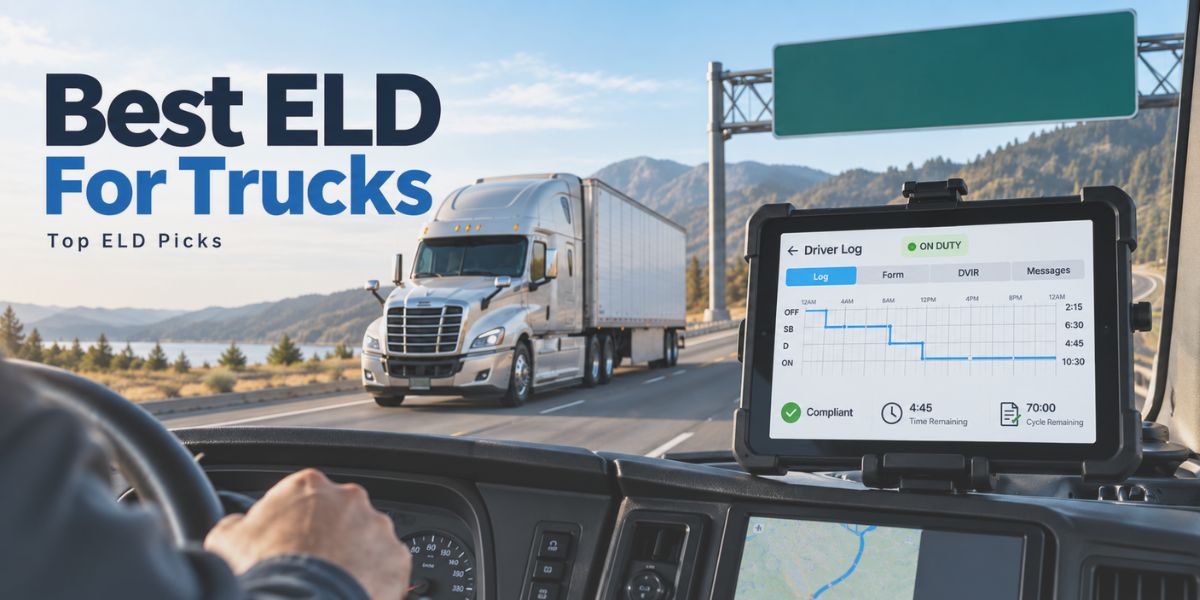
Electronic Logging Devices (ELDs) are required for most commercial trucks to record Hours of Service and present logs during roadside inspections. For truck owners in 2026, the decision is no longer about adoption but about selecting a compliant device that does not inflate operating costs.

Affordability in the ELD market is shaped by total ownership cost rather than hardware alone. Monthly subscription fees, contract length, core logging functions, and ease of use determine whether an ELD remains practical over time.

Cost sensitivity is rising as pricing becomes more standardized across providers. Early-2026 market data shows that entry-level ELD plans for trucks commonly fall between $20 and $30 per vehicle per month, making informed comparison essential for maintaining compliance without reducing margins.

Our Top Picks For 5 Most Affordable ELDs in 2026

  • Best For: Fleets seeking monthly plans with no upfront cost
  • Cost: Free device, $19.95/month
  • Key Benefits: No upfront cost, month-to-month flexibility, quick installation
Jump to Product
  • Best For: Independent drivers or small fleets preferring a one-time purchase
  • Cost: $249.99 (one-time)
  • Key Benefits: One-time purchase with no ongoing fees, secure data storage on smartphone, compatible with Garmin dÄ“zl GPS units
Jump to Product
  • Best For: Small to mid-sized fleets needing simple compliance
  • Cost: $295 (one-time)
  • Key Benefits: No subscription, paperless operations, easy for small fleets
Jump to Product
  • Best For: Fleets needing flexible payment options with real-time tracking
  • Cost: $39.95 hardware + $14.95/month service
  • Key Benefits: BYOD option, real-time tracking, 24/7 support
Jump to Product
  • Best For: Small fleets moving from paper to digital compliance
  • Cost: $250 (one-time)
  • Key Benefits: Affordable one-time cost, mobile app, document storage and transfer
Jump to Product

How Did We Test the Cheapest ELD for Trucks?

We tested affordable ELD devices based on whether they meet FMCSA requirements and perform reliably in daily truck operations. Each device was reviewed for log accuracy, engine data capture, installation time, and inspection readiness.

Cost evaluation focused on real operating expenses rather than advertised pricing. Subscription fees, contract terms, required add-ons, and access to essential functions such as log edits and driver certification were examined.

All devices were assessed under comparable usage conditions common to owner-operators and small trucking fleets. This allowed a clear comparison of compliance reliability and cost efficiency without weighting non-essential features.

What Are The Most Affordable ELDs In 2026?

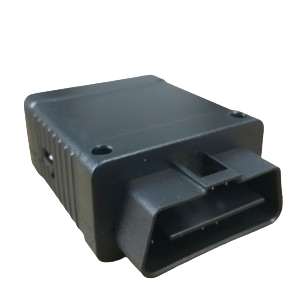
1. Matrack ELD – Most Affordable

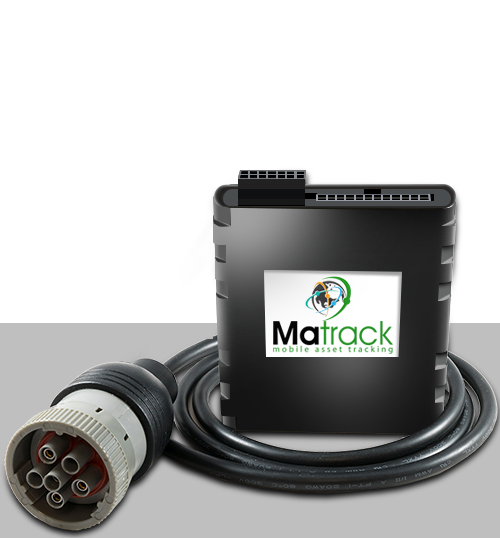
Matrack ELD reduces compliance cost by removing upfront hardware requirements and relying on a subscription-based activation model. This allows fleets to deploy ELDs without allocating capital to devices.

The system centralizes vehicle activity, driver status, and inspection data within one dashboard. Access to live operational data supports compliance checks without expanding administrative workload.

Hours of Service logs, inspection mode, and electronic DVIR are included as core functions rather than paid add-ons. Billing terms remain adjustable, which suits fleets managing variable truck utilization.

Pros Cons
✅ Affordable with no upfront device cost. ❌ Monthly fees may add up over time.
✅ Month-to-month payment flexibility. ❌ Advanced features might be limited at the base price.
✅ Quick plug-and-play installation.
Pros
✅ Affordable with no upfront device cost.
✅ Month-to-month payment flexibility.
✅ Quick plug-and-play installation.
Cons
❌ Monthly fees may add up over time.
❌ Advanced features might be limited at the base price.
  • Free device, starting at $19.95/month with no contract
  • Automatic Hours of Service (HOS) tracking and violation alerts
  • DOT inspection mode accessible via mobile
  • Real-time vehicle tracking and IFTA reporting
  • Electronic DVIR and compliance monitoring

2. Garmin eLog – Best for Independent Drivers

Garmin eLog follows a device-ownership model that replaces monthly service fees with a one-time hardware purchase. This approach appeals to independent drivers seeking fixed compliance costs.

Log records are stored through a mobile application that supports roadside inspection transfers. Data access does not depend on external fleet platforms.

Hours of Service time is recorded through the vehicle connection and synchronized with the app. Compatibility with Garmin navigation tools keeps routing and compliance data within the same system.

Pros Cons
✅ No ongoing fees, only one-time cost. ❌ Limited advanced features compared to subscription models.
✅ Secure data storage on personal devices. ❌ Compatibility restricted for some vehicle types (no OBD2 support).
✅ Easy setup and integration with Garmin dēzl GPS.
Pros
✅ No ongoing fees, only one-time cost.
✅ Secure data storage on personal devices.
✅ Easy setup and integration with Garmin dēzl GPS.
Cons
❌ Limited advanced features compared to subscription models.
❌ Compatibility restricted for some vehicle types (no OBD2 support).
  • One-time purchase at $249.99 with no subscription fees
  • FMCSA-compliant HOS logging stored locally on the smartphone
  • Compatible with 9-pin and 6-pin ports, fits most trucks
  • Bluetooth connectivity for easy data access

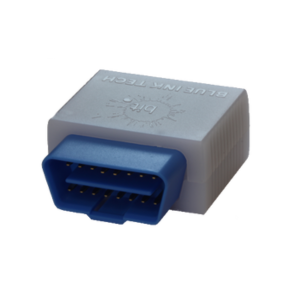
3. BIT ELD – Best for Small Fleets

BIT ELD limits its feature set to compliance-critical functions to control recurring costs. This structure avoids charging small fleets for advanced fleet analytics they do not require.

The platform supports digital DVIRs, split sleeper berth rules, and automated HOS calculations. Fuel usage data is also captured for IFTA reporting without separate software.

Pricing remains stable across fleet sizes with minimal feature expansion. The system prioritizes regulatory coverage over operational scaling.

Pros Cons
✅ Affordable one-time cost. ❌ No real-time vehicle tracking.
✅ Paperless operations reduce manual tracking. ❌ Limited feature set for larger fleets.
✅ Suitable for small to mid-sized fleets.
Pros
✅ Affordable one-time cost.
✅ Paperless operations reduce manual tracking.
✅ Suitable for small to mid-sized fleets.
Cons
❌ No real-time vehicle tracking.
❌ Limited feature set for larger fleets.
  • One-time cost of $295 with no recurring fees
  • Automatic HOS logging, co-driver support, split-shift calculation
  • Paperless DVIR and IFTA reporting
  • Simple, driver-friendly mobile app

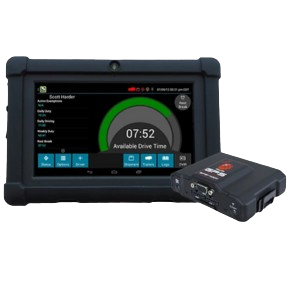
4. GPS Insight ELD – Best for Real-Time Tracking

GPS Insight ELD combines compliance logging with continuous vehicle location reporting. This allows fleets to monitor activity without deploying separate tracking systems.

Driving status and movement data update throughout the operating day. Hours of Service accuracy improves as logs reflect actual vehicle behavior.

Managers access data through mobile and web interfaces. Support tools focus on inspection readiness and daily oversight rather than advanced optimization.

Pros Cons
✅ Flexible payment options, including BYOD. ❌ Requires a monthly fee for full functionality.
✅ Affordable monthly plan with 24/7 support. ❌ Setup and cost depend on chosen features.
✅ Real-time tracking and compliance.
Pros
✅ Flexible payment options, including BYOD.
✅ Affordable monthly plan with 24/7 support.
✅ Real-time tracking and compliance.
Cons
❌ Requires a monthly fee for full functionality.
❌ Setup and cost depend on chosen features.
  • Hardware starts at $39.95; service fees from $14.95/month
  • BYOD-compatible, reducing initial hardware costs
  • Real-time HOS logging and fleet tracking
  • 24/7 support and multi-language options

5. Gorilla Safety ELD – Best for Easy-to-Use

Gorilla Safety ELD is built around a mobile-based workflow that replaces paper logs and manual forms. The interface reduces training requirements for drivers and supervisors.

Drivers complete inspections, certify logs, and upload documents through a single application. Records remain structured without additional back-office systems.

Hours of Service entries follow standard FMCSA rules and remain available for inspections. The platform emphasizes usability and regulatory documentation over expanded fleet control.

Pros Cons
✅ Affordable with no ongoing fees. ❌ Limited features for complex fleet needs.
✅ Easy for drivers to operate with mobile support. ❌ Primarily suited for smaller fleets.
✅ Supports document storage and transfer.
Pros
✅ Affordable with no ongoing fees.
✅ Easy for drivers to operate with mobile support.
✅ Supports document storage and transfer.
Cons
❌ Limited features for complex fleet needs.
❌ Primarily suited for smaller fleets.
  • One-time cost of $250, no recurring fees
  • Simple HOS logging, document upload, and eDVIR
  • Self-auditing and mobile document transfer
  • Mobile app for smartphone-based compliance

Who Needs Which ELD Device?

Matrack ELD

Matrack ELD fits small to large fleets that need the most affordable path to compliance without upfront hardware investment. It works best for operations that want flexibility while keeping compliance costs controlled.

Garmin eLog

Garmin eLog is ideal for independent drivers who prefer owning their ELD without managing ongoing service commitments. It suits straightforward operations where compliance is required without fleet-level management.

BIT ELD

BIT ELD works well for small fleets that need structured compliance without real-time tracking or complex tools. It fits operations focused on accurate logs, digital DVIRs, and cost-efficient reporting.

GPS Insight ELD

GPS Insight ELD is suited for fleets that require real-time vehicle visibility alongside affordable compliance. It supports dispatch-driven operations where live updates inform daily decisions.

Gorilla Safety ELD

Gorilla Safety ELD is best for fleets transitioning from paper logs to digital compliance with minimal training. It fits small teams that prioritize ease of use and straightforward logging.

Buying Guide For Affordable ELDs in 2026

Affordable electronic logging devices (ELDs) are essential for commercial vehicle compliance without overspending. Here are the core aspects to consider when selecting a cost-effective ELD:

Cost Range 

ELDs start at $150 per unit, typically with a monthly service fee between $10 and $50. To lower upfront costs, some providers offer bring-your-own-device options and leasing plans.

Compliance 

Ensure the device meets the U.S. FMCSA standards, as compliance is mandatory for legal operation.

Productivity Features 

Many affordable ELDs include real-time tracking of driver hours, enabling efficient route planning and scheduling to reduce downtime.

Data Reporting 

Basic data reporting and analyzing are often available in affordable ELDs. These provide insights into driver behavior and vehicle performance to help improve operational efficiency. Selecting an affordable ELD with these core features allows businesses to stay compliant and efficient while managing costs.

Frequently Asked Questions

1. Are affordable ELD devices legal for FMCSA compliance?

Yes, affordable ELD devices are legal if they are registered with the FMCSA and meet all technical requirements. Cost does not affect compliance as long as the device records, stores, and transfers HOS data correctly.

2. How much does an affordable ELD usually cost per truck in 2026?

Most affordable ELD solutions in 2026 range between $20 and $30 per truck per month. Pricing varies based on subscription models, hardware ownership, and included features.

3. Do low-cost ELDs support roadside inspections?

Yes, all FMCSA-compliant ELDs, including low-cost options, must include an inspection mode. This allows officers to review or receive log data electronically during inspections.

4. Can owner-operators use the same affordable ELDs as small fleets?

Yes, many affordable ELDs are suitable for both owner-operators and small fleets. The main difference is usually pricing structure, not compliance capability.

5. Are affordable ELD devices difficult to install?

Most affordable ELDs use plug-and-play connections that install within minutes. Installation complexity is generally the same as higher-priced systems.

6. Do budget ELDs include electronic DVIR functionality?

Many affordable ELDs include electronic DVIR as a standard feature. Some may limit reporting depth, but DVIR compliance requirements are still met.

7. Do cheapest ELDs provide vehicle location tracking?

Some affordable ELDs include basic GPS tracking, while others focus only on compliance logging. Real-time tracking is not required under FMCSA regulations.

8. Is data retention reliable with low-cost ELD providers?

FMCSA rules require ELD data to be retained for a minimum period regardless of price. Compliant affordable providers meet the same retention standards as premium platforms.

9. Can drivers edit logs on affordable ELD devices?

Yes, affordable ELDs allow drivers to suggest log edits when corrections are needed. Edits are tracked and must be certified to remain compliant.

10. What should be prioritized when choosing an affordable ELD in 2026?

FMCSA registration, total cost of ownership, and ease of daily use should come first. Extra features matter less than consistent compliance and stable pricing.

Conclusion

In 2026, affordable ELD options such as Matrack ELD, Garmin eLog, and BIT ELD allow fleets to meet FMCSA requirements without unnecessary spending. Each solution delivers core compliance features while supporting different budget structures.

Matrack suits fleets that prefer flexible monthly costs, while Garmin eLog and BIT ELD support operators who want compliance without recurring subscriptions. This variety allows small fleets and independent drivers to choose an option that aligns with their financial priorities.

Although each ELD offers a different approach, all five focus on accurate HOS tracking, simple setup, and cost efficiency. Selecting the right affordable ELD helps fleets remain compliant while keeping operational expenses under control.