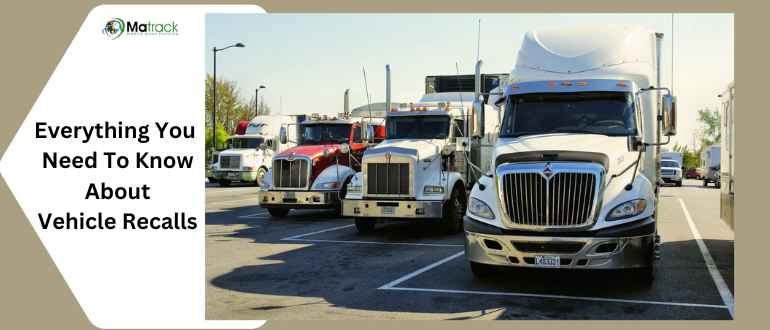


What Does a Vehicle Recall Mean?
Vehicle recall means an automaker has identified a safety defect or a noncompliance with motor vehicle safety standards in a specific vehicle model, component, or production batch. An issue is officially recognized after internal testing, field data, or regulatory review confirms a potential safety risk.
Affected vehicles are identified through VIN range, model year, or manufacturing period, and an official recall notice is issued to inform owners. The objective is to eliminate the risk through inspection, repair, part replacement, or a software update performed by an authorized dealer.
Why Are Vehicles Recalled?
Recalls occur when a confirmed fault, performance gap, or regulatory violation creates a measurable risk to vehicle safety or operational reliability.
- Design defect: Engineering limitations or miscalculations can affect how a system behaves under real-world conditions.
- Production defect: Errors during assembly, calibration, or material handling can reduce consistency across manufactured units.
- Supplier issue: Third-party components may fail quality checks or degrade faster than expected in use.
- Regulatory violation: Failure to meet motor vehicle safety standards can trigger mandatory corrective action from authorities.
- System malfunction: Failures in integrated systems such as control units or mechanical linkages can disrupt normal vehicle operation.
- Data-driven detection: Patterns from customer complaints, dealer reports, warranty claims, or regulatory investigations can reveal widespread defects across multiple units.
How Does Vehicle Recall Work?
Vehicle recall works through a connected process that moves from defect discovery to owner notification and final repair.
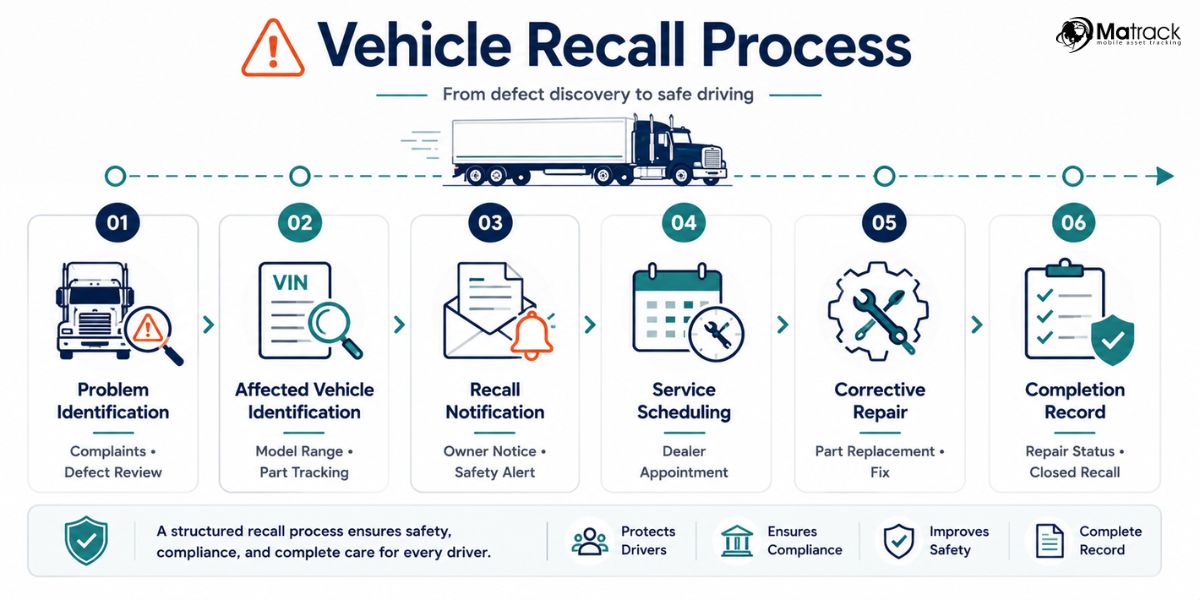
Problem Identification
Problems usually surface through customer complaints, dealer inspections, warranty claims, crash reports, or internal quality reviews. Once similar failures appear across more than one vehicle, engineers can trace the pattern to a shared part, system, or production batch.
Affected Vehicle Identification
After the fault is confirmed, production records and component history are reviewed to find which vehicles carry the same condition. That review helps narrow the scope by model year, build range, factory batch, or installed part configuration.
Recall Notification
Owners of affected vehicles receive an official recall notice that explains the defect, the possible hazard, and the corrective action available. Recall details are also published on official manufacturer and safety databases so drivers can verify status through trusted sources.
Service Scheduling
The owner then contacts an authorized dealership or service center to arrange the repair. Appointment timing may vary based on parts supply, repair complexity, and service capacity at the selected location.
Corrective Repair
Technicians inspect the vehicle and complete the approved remedy based on manufacturer instructions. Repair may involve part replacement, hardware correction, software recalibration, or another fix designed to remove the safety risk.
Completion Record
Once service is finished, repair status is added to the vehicle’s recall history. Updated record helps confirm that the required corrective action has been completed and no open campaign remains for that fault.
Who Issues and Manages Vehicle Recall?
Vehicle recall is issued by the manufacturer and managed through a coordinated process involving the automaker, safety authority, and authorized dealership.
Manufacturer
The manufacturer confirms the safety defect, identifies the affected vehicle group, and opens the recall campaign under the required safety framework. Recall notice, repair method, replacement parts, and technical instructions are prepared at this stage so the fault can be corrected across all impacted units.
Safety Authority
Safety authority reviews the reported defect and checks whether the response meets established motor vehicle safety standards. Consumer complaints, risk data, recall filings, and compliance records may all be examined as part of that oversight.
Authorized Dealership
An authorized dealership handles the corrective work linked to the campaign. Inspection, part replacement, system correction, or software installation is completed according to the service guidance issued for the affected vehicles.
Vehicle Owner
The vehicle owner closes the loop by responding to the recall notice and arranging service for the affected vehicle. Repair only becomes effective after the vehicle reaches the dealer and the approved correction is completed.
How Can You Check if Your Vehicle Has an Open Recall?
Open recall status can be checked through official manufacturer platforms, government recall databases, or dealership service records.
Vehicle Identification Number
Recall search usually starts with the Vehicle Identification Number, since this code links the check to a specific vehicle instead of a general model. Registration papers, insurance documents, the dashboard near the windshield, or the driver-side door area usually display this number.
Official Recall Database
Government recall databases and manufacturer recall portals provide accurate information about active safety campaigns. Results typically include the defect summary, affected component, risk level, and current remedy status.
Manufacturer Website
Manufacturer websites offer dedicated recall lookup tools connected to their service systems. These platforms may also show repair availability, campaign reference details, and guidance for the next step.
Authorized Dealership
Authorized dealerships can verify whether an open recall exists and explain the required corrective action. Service team can also check parts availability and assist with scheduling the repair.
Recall Notice
Mail notice, email alert, or service communication may inform the owner about an active recall. Message usually outlines the defect, associated risk, and where the vehicle should be taken for correction.
What Should You Do After Finding a Recall?
After finding an open recall, response should move from verification to repair planning so the safety issue does not remain unresolved.
Review Recall Information
Recall details should be read carefully to understand the affected component, risk description, and corrective action. Notice may also explain whether the problem involves urgent safety exposure or standard service handling.
Confirm Vehicle Status
Open campaign status should be confirmed through an official source before moving ahead with service. Check helps verify whether the recall is still active, already completed, or waiting for remedy availability.
Contact Authorized Dealership
Authorized dealerships should be contacted to discuss the recall and confirm the required service process. Service advisors can explain repair availability, estimated visit requirements, and related campaign details.
Check Parts Availability
Parts status should be confirmed before scheduling the visit, especially in recalls involving high-volume vehicle models or specialized components. Limited supply can affect service timing and dealer readiness.
Schedule the Repair
Service appointments should be booked as soon as repair support becomes available. Prompt scheduling helps reduce risk and prevents the vehicle from remaining under an open safety campaign.
Keep Repair Documentation
Completed work should be saved in the vehicle’s service history for future reference. Documentation supports resale review, ownership transfer, and proof that the corrective action was completed.
Final Thoughts
Vehicle recall plays a critical role in maintaining road safety, regulatory compliance, and long-term vehicle reliability. Timely action from the manufacturer, supported by proper response from the owner, ensures that identified risks do not turn into real-world failures.
Regular recall checks, clear understanding of the process, and prompt repair completion help keep vehicles safe and compliant. Staying aware of open recalls is a simple but essential step in responsible vehicle ownership.
Frequently Asked Questions
Can a used car still have an open recall?
Yes, a used car can still have an open recall since recall status is linked to the vehicle, not the owner. Checking recall history before or after purchase helps ensure no unresolved safety issue remains.
Are Recall Repairs Free?
Recall repairs are usually free when the vehicle falls under an active safety campaign issued by the manufacturer. Cost coverage applies only to the defect listed in the recall, while unrelated repairs may involve charges.
Is It Safe to Drive a Recalled Vehicle?
Driving may be possible in some cases, but risk depends on the severity of the defect and the affected system. Recall notice or dealership guidance should be followed, especially for issues linked to braking, steering, or fire hazards.
Do Vehicle Recalls Apply to Used Cars?
Yes, recalls apply to all affected vehicles regardless of ownership history. Responsibility remains with the current owner to check status and complete the required repair.
What Happens if There Is No Fix Yet?
Some recalls are announced before the final remedy is ready, which means repair is not immediately available. The manufacturer usually provides updates and issues a follow-up notice once the corrective solution is prepared.
What Is the Difference Between a Recall, a Warranty Issue, and a Service Campaign?
Recall addresses a verified safety defect or regulatory noncompliance and includes an official corrective action. Warranty issue relates to coverage terms for repairs, while a service campaign targets non-critical improvements without the same safety or legal implications.